Information as of September 2026. We cover Lombok’s seasons as a whole in our guide to Lombok’s seasons and weather; this guide focuses on the Christmas and New Year period (late December to early January) and looks in detail at what is specific to that time: weather, prices, crowds and public holidays.
What this guide covers
- ✓The conclusion first: over Christmas and New Year Lombok is at the peak of the rainy season, but it is less crowded than Bali, and the rain comes as downpours rather than all-day rain, so it is still worth going
- ✓What official BMKG data says about rainfall and sea conditions from late December to early January
- ✓Typical prices for flights and accommodation (in rupiah), and when to book
- ✓Crowds on the Gili Islands at year end, and the risk of boats being cancelled in high seas
- ✓Indonesian public holidays, New Year’s Eve, and Mount Rinjani in January (when it is closed)
The conclusion: is Lombok worth visiting over Christmas and New Year?
Here is the conclusion first. Data from BMKG (Indonesia’s meteorology agency) shows that the year-end period falls in one of the wettest parts of Lombok’s rainy season. If all you want is the highest chance of sunshine, the dry season (roughly May to September, extending to October in some years) is the safer choice. We explain this in detail in our guide to Lombok’s seasons and weather.
Even so, we do not think this period is “not worth it”, for three reasons. First, much of the rainy-season rain comes as afternoon and evening downpours (heavy, short bursts that do not last long), and mornings are often clear. Second, compared with Bali, crowds are less concentrated even at year end. Third, although flights and accommodation cost more, it is a realistic option compared with Bali’s price rises and crowds at the same time.
On the other hand, there are drawbacks we have to be honest about: some days the sea is too rough for snorkelling or diving, fast boats to the Gili Islands can be cancelled in high seas, you basically cannot climb Mount Rinjani, the risk of mosquito-borne diseases rises, and you need to watch out for floods and landslides. We explain each of these in the sections below.
For BMKG’s rainy-season data, monthly rainfall patterns and the risk of boat cancellations, see our guide to enjoying Lombok in the rainy season (November to March).
Typical prices for flights and accommodation, and when to book
Typical prices (as of August 2026)
The prices below are a rough guide based on what price comparison sites showed in August 2026. Year-end prices tend to be peak-season prices, so assume they will be higher than in the table.
← Scroll the table sideways
| Item | Typical price, normal season | Notes |
|---|---|---|
| Bali (DPS) to Lombok (LOP), one way | Rp500,000 to 1,200,000 | The cheapest fares start at around US$19 (about Rp340,000) |
| Mid-range accommodation on Lombok, per night | Rp600,000 to 1,500,000 | Luxury villas and resorts cost several times this. Guesthouses from around Rp200,000 |
The prices in this table do not guarantee any particular flight or accommodation. For international flights, check actual fares directly in the date calendars on airline websites such as Garuda Indonesia. How much prices rise at year end varies greatly by year, route and property. We set out how to think about overall costs in our guide to costs and prices.
Why flights get hard to book
Many international travellers reach Lombok by connecting in Bali, Jakarta, Kuala Lumpur or Singapore. Over Christmas and New Year, flights through Bali (Denpasar), the most common connecting point, are busy with holiday travellers.
On top of that, year end coincides with domestic travel demand in Indonesia. Each year, Indonesia’s Ministry of Transportation adds extra services and lowers fares as a policy measure to cope with increased demand over the Christmas and New Year period (Nataru). For Nataru 2025/2026, the following discounts were introduced under a joint decree (SKB) of the ministry.
← Scroll the table sideways
| Transport | Discount | Period |
|---|---|---|
| Air (domestic economy) | Cut by 13 to 14% | From late October 2025 |
| Rail (economy commercial trains) | 30% off | 22 December 2025 to 10 January 2026 |
| Sea transport (economy) | 20% off the base fare (about 16 to 18% off the total) | 17 December 2025 to 10 January 2026 |
| Ferries (penyeberangan) | Port service charges waived (about 19% less on average) | 22 December 2025 to 10 January 2026 |
All of these are policies for domestic transport in Indonesia and do not apply to international flights.
For Nataru 2026/2027, the government set out fare reductions in an economic stimulus announcement on 22 June 2026, and the Deputy Coordinating Minister for Economic Affairs announced the details in November 2026 (as reported in November 2026): 30% off economy commercial rail fares (22 December 2026 to 4 January 2027), 30% off the base fare for PELNI economy class (17 December 2026 to 10 January 2027), port service charges waived on 8 ASDP ferry routes at 14 ports (22 December 2026 to 10 January 2027), and about 11 to 12% off domestic flights, with the government covering the full value added tax (PPN) and a 50% cut in airport service charges (PJP2U and PJP4U) (22 December 2026 to 10 January 2027). As in the previous year, they do not apply to international flights. Check each operator’s information on eligible routes and how to buy before you travel.
When should you book?
Note that measures to “lower fares” at year end do not make seats “easier to get”. In fact, Lombok International Airport handled 171,241 passengers during the Nataru 2025/2026 period, up 15.7% from 147,974 the year before, with a peak of 10,682 people on 28 December 2025 (announced by the airport operator InJourney Airports). The figures show that this is a time of year when people reliably travel.
Christmas to New Year’s Day in particular (around 24 December to 1 January) is when companies set peak-season prices. Our suggestion is to make your main bookings, both domestic flights and accommodation, by September or October at the latest. This is not a fixed deadline; read it as a guide worked out backwards from the demand figures above. Accommodation on popular islands such as Gili Trawangan is said to sometimes fill up early just for the year-end period.
Here is the booking timing as a timeline.
Figure: When flight and accommodation prices rise, and when to book
Crowds compared with Bali: Lombok’s strength
Most people considering Lombok for the year-end holidays compare it with Bali. This is where Lombok has a clear advantage.
As figures that can be compared on the same basis, here are annual airport passenger numbers.
| Airport | Passengers in 2025 |
|---|---|
| Bali, Ngurah Rai International Airport (DPS) | 24,125,161 (of which international 15,177,283) |
| Lombok International Airport (LOP) | 2,497,163 |
Both are total arrivals plus departures, so the same person travelling there and back is counted twice. They are not numbers of individual people, but because they are counted the same way, the difference in scale can be read directly: Bali’s figure is about ten times Lombok’s.
There are other statistics for Bali too. According to the Bali office of Statistics Indonesia (BPS), there were 6,948,754 foreign tourists in 2025 (up 9.72% on the previous year), and according to the Bali provincial government, the total number of tourists including domestic visitors was 16.3 million. These two and the airport passenger numbers come from different bodies and are counted differently, so they cannot simply be compared. When looking at the size of a difference, always compare figures of the same kind.
Lombok, meanwhile, is only about 50 minutes by plane from Bali (Denpasar) (121km in a straight line; scheduled time including taxiing). Even so, as the table shows, there is a big gap in how many people pass through.
Even at year end, you will not be troubled by traffic jams or full restaurants as often as in Bali’s main areas. For Lombok as a whole, this difference in crowds is one of the biggest reasons to choose it if you “do not want Bali’s bustle but would like a quiet year-end holiday”.
The Gili Islands at year end: crowds and boat cancellations
The exception on Lombok, busy at year end, is the Gili Islands, especially Gili Trawangan. It is a standard Christmas and New Year destination for travellers from Europe and Australia, and booking accommodation and restaurants early is said to be necessary at this time. Accommodation in particular fills up earlier than in other areas.
What is easily overlooked is the risk of boats being cancelled. The usual way to the Gili Islands is by fast boat, but as mentioned, year end is when the sea tends to be rough. BMKG issues high-wave warnings for waters including the Lombok Strait, and at the port authority’s discretion, services from Bangsal can be suspended for the whole day.
This should be seen not as “a rare exception” but as something that can happen every rainy season. If you include a day trip or stay on the Gili Islands over year end, we strongly recommend leaving slack for the return (do not schedule Gili crossings on your last day, and be back on mainland Lombok the day before your flight).
To be accurate about alternatives: from Bangsal harbour, besides fast boats, there are public boats (perahu umum, traditional boats that leave once enough passengers have gathered, running roughly from 8am to 5pm), and they cost considerably less than fast boats. However, it is dangerous to assume public boats will still run in bad weather.
In Indonesia, a vessel needs a sailing approval letter (Surat Persetujuan Berlayar, SPB) issued by the harbour master (syahbandar) to leave port. On 18 November 2025, the Ministry of Transportation instructed harbour masters nationwide not to issue SPBs in extreme weather, explicitly including small vessels under 35 tonnes, tugboats, LCTs and roll-on/roll-off ships. In other words, when the port authority stops departures, no vessel of any type sails. Do not count on being able to cross by public boat when fast boats are cancelled.
Also take geography into account. Lombok International Airport is in the south of the island and Bangsal harbour, the gateway to the Gili Islands, is in the northwest, so you need a long road journey across the island. In the rain, the travel time on this stretch becomes even harder to predict. We cover getting from the airport in our Lombok airport guide. Assume there is no reliable alternative route, and leave slack in your schedule.
Indonesian public holidays and New Year’s Eve
Public holidays at the end of 2026
According to the joint decree (SKB) of three ministries (Religious Affairs, Manpower and State Apparatus Empowerment) announced on 19 September 2025 (Ministry of Religious Affairs decree 1497/2025 and others), the end of 2026 looks like this.
| Date | What it is |
|---|---|
| Thursday 24 December 2026 | Joint leave (cuti bersama) |
| Friday 25 December 2026 | Public holiday (Christmas / Natal) |
Friday 25 December is a holiday and 26 and 27 December are a weekend, so in Indonesia 24 to 27 December easily feels like a long weekend. As of August 2026, we could find no official document confirming specific closures of government offices or bank counters during this time. Since these are a public holiday and a joint leave day, assume counters will not be open, and take care of money-changing or other errands on the weekdays before or after.
New Year’s Day (1 January) is a public holiday every year. The 2027 joint decree was announced on 15 September 2026: Friday 1 January 2027 is a public holiday, with no joint leave days around it. Officially, then, there is only a three-day weekend from Friday 1 to Sunday 3 January, not a longer break like 24 to 27 December 2026. For details, check the Indonesian State Secretariat website.
New Year’s Eve events
New Year’s Eve (31 December) is marked across Indonesia as the day to welcome the new year, regardless of religion. However, there is not necessarily a countdown event or fireworks on Lombok every year.
As an example, on the night of 31 December 2025 in Mataram, the provincial capital, there was no official city countdown and no fireworks display. The mayor of Mataram said there would be “no central event”, and the city focused on security and patrols (it was reported that remembering the victims of a disaster in Aceh, Sumatra, took priority at the time).
On the other hand, in some years Senggigi, Gili Trawangan, Kuta Lombok and Taman Sangkareang in Mataram are featured as places to see in the new year, and hotels and resorts sometimes announce their own countdown events.
In short, some years there are events and some years there are not. We do not recommend making a New Year event the purpose of your trip. If you plan to attend one, always check that year’s announcements on the venue’s official social media or in local media just before you travel.
Christmas and New Year on an island where most people are Muslim
In West Nusa Tenggara (NTB), the province that includes Lombok, 96.83% of the population is Muslim (Ministry of Home Affairs population and civil registration data, June 2021). Lombok is also known as “the island of a thousand mosques”.
One common misunderstanding is worth correcting, though. New Year on Bali is not a religious event either. The Hindu (Saka) New Year is Nyepi, which usually falls in March. On 31 December and 1 January, Bali’s celebrations are mainly countdown events for tourists. The difference from Lombok is not “whether there is a religious event” but the scale and number of events.
On Lombok, Christmas and New Year tend to pass relatively quietly as “national holidays and events”. At the same time, Mataram, the provincial capital, has Catholic and Protestant churches, and local media report Christmas Masses held by the Christian minority. Year end passes with the majority and minority coexisting, which is closer to the reality.
What travellers should watch is opening hours. In mostly Muslim areas there are fewer shop events celebrating Christmas or New Year than on Bali, but neither is there a strong idea of “closing because it is year end”. Staff may take public holidays off, however, so small family-run shops and tours may close for a few days around Christmas and New Year.
Mount Rinjani in January: you basically cannot climb
If you are planning a trek up Mount Rinjani (3,726m), the symbol of Lombok, there is something you need to know first. Mount Rinjani National Park (TNGR) usually closes all climbing routes from January to around March, because of the risk of weather-related disasters in the rainy season and to protect the ecosystem. TNGR officially gives as its reasons “high risk due to the rainy season (slippery trails, fog, routes cut off by water)”, “a recovery period for nature” and “maintenance of trails and facilities”.
Most recently, TNGR closed all six main routes, Senaru, Torean, Sembalun, Timbanuh, Tetebatu and Aik Berik, from 1 January to 31 March 2026, and reopened them on 1 April 2026 (there were reports of reopening on 28 March at first, but the official reopening date was 1 April). So in late December you may be able to climb, but you basically cannot include a Rinjani climb in early January.
As of 15 November 2026, the Mount Rinjani National Park official website had not yet announced closure dates from January 2027. The closure at this time of year is a pattern repeated almost every year, but the length of the closure and the reopening date vary from year to year and with the weather and on-site assessments. If you plan to climb Rinjani over the holidays, limit it to dates in December, check the announcements on the Mount Rinjani National Park official website before you travel, and plan on switching to other activities from January.
Activities that suit this time of year, and those that do not
The following is our view as of August 2026. Whether something is possible on the day depends on the weather and on each operator’s decision.
Opinions are most often divided between waterfalls and cultural experiences on one hand, and island boat trips and climbing on the other.
Figure: What suits the year-end period and what does not (with reasons)
You can also check the detailed reasons by activity in the tables below.
| Suits | Why |
|---|---|
| Beaches and snorkelling in the morning | Easier to avoid afternoon downpours (but called off at any time of day when there is a high-wave warning) |
| Countryside and rice terraces in the green season | Plants are lush in the rainy season, and the scenery is different from the dry season |
| Longer, slower stays at cafes and your accommodation | Less affected by weather; you can wait out the downpours |
| Roofed cultural sites and traditional villages | Work well even in the rain |
| Does not suit | Why |
|---|---|
| Trekking Mount Rinjani | Basically closed in January (see above) |
| Rushed trips to the Gili Islands (quick day trips, travel on the same day) | High risk of plans falling apart if boats are cancelled in high seas |
| Plans for whole days outdoors | Easily spoiled by afternoon downpours |
| Packed diving schedules | Dives may be called off on the day because of rough seas |
| A trip built around a New Year’s Eve event | Some years there are none, so it is hard to confirm in advance |
Back-up plans for bad-weather days
Having alternatives ready for when rain or rough seas stop your planned sea activities keeps your overall trip from being spoiled.
- Visits to traditional villages to experience Sasak culture (mostly visits to villages with roofed buildings; Sade is being rebuilt after a fire in August 2026 and, as of 12 October 2026, its formal relaunch was still being prepared, so check before you go)
- Shopping at shopping centres and markets in Mataram, and visits to workshops selling Lombok’s own textiles and crafts
- Spa treatments and massages at your accommodation, and relaxing by the pool
- Long stays at cafes (Wi-Fi varies from place to place, so do not expect too much)
- Visits to waterfalls and streams, which have more water and more to see in the rainy season (access may be restricted when water levels are high, so follow local guidance)
The key to enjoying Lombok at year end is not “it is raining so there is nothing to do”, but building these into your plans from the start as “how to spend the rainy season”.
Cautions and drawbacks at a glance
To be honest, Lombok at year end has the following drawbacks that other seasons do not.
- It is the peak of the rainy season: BMKG’s announcement for the 2025/2026 season expected monthly rainfall of 300 to 500mm in December and January in Java, Bali, Nusa Tenggara and elsewhere. The peak for southern and eastern Indonesia was forecast for January to February, so early January is already within the peak
- Higher risk of mosquito-borne diseases: dengue occurs throughout Indonesia and is common during the rainy season (Australia’s Smartraveller). Indonesia’s Ministry of Health also lists dengue as a priority disease in the rainy season. We recommend protecting yourself from mosquitoes with long sleeves, repellent and checking your accommodation’s screens or mosquito nets, and taking out travel insurance
- Risk of floods, landslides and lightning: BMKG’s year-end advisories are mainly about preparing for weather-related disasters. Mountain roads and areas along streams may be closed or have restricted access after rain
- Risk of boat cancellations: when there is a high-wave warning, fast boats to the Gili Islands may be suspended for the whole day. If the harbour master does not give sailing approval, all vessels, public boats included, stop, so there is no reliable alternative
- Long road journeys: the airport is in the south of the island and Bangsal harbour, the gateway to the Gili Islands, is in the northwest, so you have to cross the island. In the rain, journey times are even harder to predict
- Some shops and tours may close: family-run shops and tour companies may close for a few days around the public holidays (Christmas and New Year’s Day)
- Prices go up: flights and accommodation tend to be at peak-season prices, and if you book at the last minute you may not get the flight or room you want
- No Rinjani climbing from January: you cannot include a trek in early January
With all this in mind, for people who “do not mind the rainy season” and “want something quieter than Bali”, Lombok at year end is a realistic choice.
Frequently asked questions (FAQ)
Frequently asked questions
Q. Does it rain all the time on Lombok at year end, so there is no point sightseeing?
It does not rain all day; the rain is said to come mainly as afternoon and evening downpours. If you plan outdoor activities for the morning and use the afternoon for indoor activities or travel, you can enjoy the rainy season. It is true, though, that there are more cloudy and rainy days than in the dry season, and that January falls in the peak period in BMKG’s forecast.
Q. Is the sea safe in the morning?
“Doing it in the morning” helps with the downpours that are more common in the afternoon. High waves do not die down by time of day, and BMKG’s high-wave warnings are issued for periods. On days with a warning, plan on cancelling sea activities regardless of the time.
Q. I plan to go to the Gili Islands over the holidays. What do I do if the boat is cancelled?
When a high-wave warning is issued, services may be suspended for the whole day at the port authority’s discretion. In Indonesia, leaving port requires the harbour master’s approval letter (SPB), which is not issued in bad weather, including for small vessels and ferries. Bangsal harbour also has public boats, but they stop for the same reason, so they are not a reliable alternative. We recommend a schedule with slack: do not schedule Gili crossings on your last day, and be back on mainland Lombok the day before your flight.
Q. By when should I book flights and accommodation?
As a guide, having your main bookings done by around September to October is reassuring. At year end, holiday travel from abroad overlaps with domestic travel demand in Indonesia, and Lombok International Airport handled 171,241 passengers during Nataru 2025/2026, up 15.7% on the year before.
Q. Can I climb Mount Rinjani in January?
Basically, no. Mount Rinjani National Park usually closes all climbing routes from January to around March; most recently they were closed from 1 January to 31 March 2026 and reopened on 1 April. If you want to climb, limit it to dates in December.
Q. Is there a Christmas or New Year atmosphere on mostly Muslim Lombok?
There are no large countdowns like on Bali. In some years there are no official fireworks or events at all in Mataram, the provincial capital (as on 31 December 2025), and whether events take place changes from year to year. On the other hand, Mataram has churches, and Masses are held by the Christian minority. Note that New Year on Bali is not a religious event either; it mainly consists of events for tourists (the Hindu New Year, Nyepi, usually falls in March).
Sources
Sources for this guide
- BMKG (Indonesian meteorology agency), Prediksi Musim Hujan 2025/2026 di Indonesia (start and peak of the rainy season)
- BMKG, Prediksi Musim Hujan 2025/2026 di Indonesia (November 2025 update)
- BMKG, Prediksi Musim (seasonal forecast page, for checking the next season’s announcement)
- BMKG Climatology Station, West Nusa Tenggara (climate information for NTB)
- BMKG, Perkuat Kesiapsiagaan Nataru 2025-2026 (forecast of 300 to 500mm a month, preparing for weather-related disasters)
- BMKG Maritim – Prakiraan Cuaca Perairan Selat Lombok Bagian Selatan
- BMKG Maritim – Peringatan Dini Gelombang Tinggi
- Kompas TV (report on an announcement by BBMKG Region III Denpasar), Waspada Dampak Bibit Siklon 96S, Gelombang 4 Meter Bayangi Perairan Bali hingga 30 Desember
- Australian Government, Smartraveller: Indonesia (dengue throughout Indonesia, common in the rainy season)
- Kementerian Kesehatan RI (Indonesian Ministry of Health), Waspada Penyakit di Musim Hujan (dengue in the rainy season)
- Dinas Kesehatan Provinsi NTB – Waspada DBD di Musim Hujan
- Sekretariat Negara Republik Indonesia – Inilah SKB 3 Menteri Libur Nasional dan Cuti Bersama 2026
- Sekretariat Negara Republik Indonesia (for checking the 2027 SKB)
- Kementerian Perhubungan (Indonesian Ministry of Transportation), SKB Stimulus Angkutan Nataru 2025/2026 Ditetapkan
- CNBC Indonesia, Beri Diskon Tiket Lebaran-Nataru 2027, Kemenhub Usul Anggaran Segini (2027 measures at the budget request stage, 13 July 2026)
- Fortune Indonesia, Pemerintah Siapkan Rp883,4 M untuk Diskon Transportasi Nataru 2026/2027 (announced by the Deputy Coordinating Minister for Economic Affairs; rail, PELNI, ferry and domestic flight discounts and periods, 9 November 2026)
- Republika, Dukung Stimulus Ekonomi Nataru 2026/2027, Tiket Kapal PELNI Diskon 30 Persen (PELNI discount and period, 8 November 2026)
- ANTARA News, Kemenhub minta Syahbandar tak beri izin berlayar saat cuaca ekstrem (18 November 2025, instruction to stop issuing SPBs and the vessel types covered)
- IDN Times NTB (report on an InJourney Airports announcement), Penumpang Bandara Lombok Tembus 2,49 Juta Orang sepanjang Tahun 2025
- NusaBali (report on an announcement by the Ngurah Rai airport GM), Bandara Ngurah Rai Layani 24,1 Juta Penumpang di 2025
- Report on a BPS Bali office announcement (ANTARA Bali), BPS catat wisman ke Bali sepanjang 2025 tembus 6,95 juta
- Bali provincial government, Kunjungan Wisatawan Bali Tembus 16,3 Juta pada 2025
- Databoks (Ministry of Home Affairs Dukcapil data), Lebih dari 96% Penduduk Nusa Tenggara Barat Beragama Islam
- Mount Rinjani National Park (TNGR), Pendakian Rinjani Ditutup Demi Keselamatan dan Kelestarian
- Kompas Travel – Bukan 28 Maret, Pendakian Gunung Rinjani Buka Lagi 1 April 2026
- Tribun Lombok, Malam Pergantian Tahun di Mataram Tanpa Pesta Kembang Api dan Hiburan (the 2025-26 New Year example)
- IDN Times NTB – 5 Rekomendasi Tempat Merayakan Malam Tahun Baru di Lombok
- IDN Times NTB – Melihat Perayaan Misa dan Natal di Pulau Seribu Masjid
- Garuda Indonesia official website (for checking actual fares)
- FlightConnections, DPS to LOP (distance and scheduled flight time)
More on this topic: Lombok Travel Essentials. Sample 3- to 5-night itineraries in Sekotong, with the cost per person: Stay Programme Itineraries.
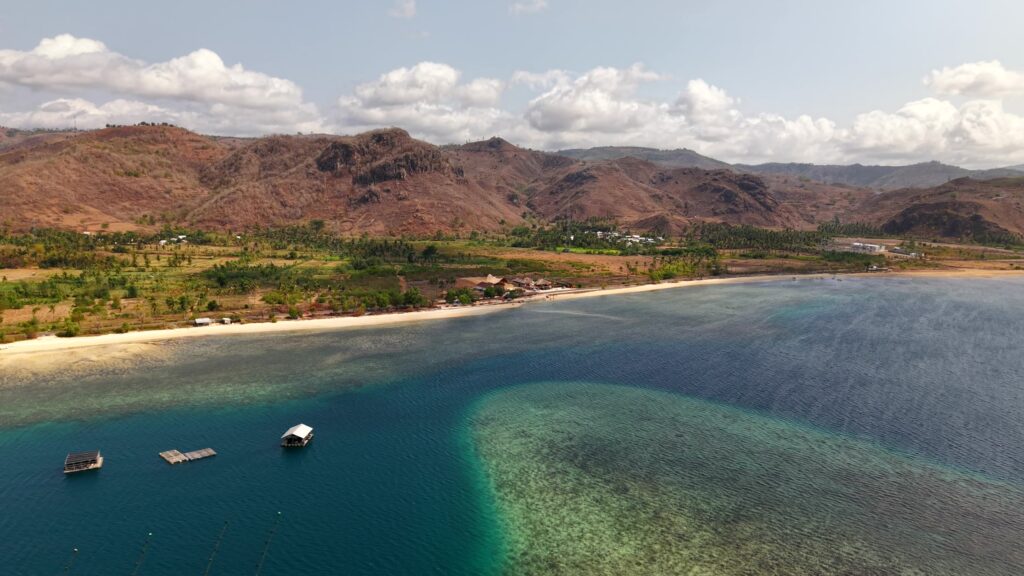
SEMELAR BEACH VILLAGE
Come and spend some time in the Sekotong village we call home
About 1 hour 10 minutes by car from Lombok International Airport. We offer a stay programme of 3 nights/4 days or more, with island trips by local boat and sunsets at SAKURA CAFE. The villas are due to be completed in stages from 2027.