As of September 2026, based on local conditions
This information is as of September 2026. Facilities and water supply vary from one place to stay to another, so please check directly with your accommodation before you travel.
If you’re thinking about a trip to Lombok, the vaguest worry that tends to linger is the bathroom side of things. Can you use the toilets the way you’re used to? Can you drink the tap water? Will the electricity work properly? It’s easy to assume you’ll just have to get used to it all once you arrive, but in reality, simply knowing how things work beforehand means you’ll hardly ever be caught out. The short answer is that the differences in Lombok’s toilets, water and electricity are all things you can handle once you know about them. In this guide we go through the differences between hotels and village areas, how to treat tap water, the electrical standard and preparing for power cuts, and typical laundry prices, one by one, as an explanation of local conditions.
What this guide covers
- ✓How toilets and water differ between hotels or villas and village areas
- ✓How to tell where you can’t flush paper, and how to use a “mandi” for manual flushing
- ✓Brushing your teeth and ice when you don’t drink tap water, and typical prices for bottled water
- ✓The electrical standard (220V, type C) and preparing on the assumption that power cuts happen
- ✓Typical laundry service prices and a list of small items worth bringing
In short: not what you may be used to, but all manageable once you know
To give the conclusion first, Lombok’s bathroom and utility situation isn’t completely different from what you know; it simply works on different assumptions. Most hotels and villas have Western-style toilets, hot showers, Wi-Fi and power sockets, so foreign visitors can get by without any special preparation. In village eateries, public facilities and local transport hubs, on the other hand, toilets where you can’t flush paper and manual flushing are still common. So the first thing to understand is that what you do depends on which kind of area you’re in. Below, we look at the reality and how to deal with it for toilets, water, showers, electricity and laundry in turn.
Figure: Toilets, water and electricity at a glance
Toilets: how you use them depends on hotel or village
Hotels and villas: mostly Western-style
Hotels and villas that expect foreign guests generally have Western-style toilets. The standard of fittings varies from place to place, but in accommodation set up for tourists you’re unlikely to be confused by how to use the toilet itself. If you want to check toilet and shower facilities when choosing where to stay, see also our guide to hotels and villas in Lombok.
Village areas and local eateries: squat toilets too
In village eateries, small shops and local bus stops, on the other hand, you may find squat toilets. The further you are from tourist routes, the more likely you are to come across this type. Using one isn’t complicated, but how paper is handled and how you flush, explained next, may be different from what you’re used to, so it helps to know in advance.
Some places can’t take toilet paper
In many places in Indonesia, the drainage isn’t designed for flushing paper. If there’s a small bin next to the toilet, that’s a sign meaning “please put used paper here”. Hotel room toilets are often designed to take paper, but in village areas and older buildings flushing paper can cause blockages, so it’s reassuring to get into the habit of checking first whether there’s a bin.
Note
Whether you can flush paper differs from place to place. When unsure, the reliable way to decide is whether a bin has been provided. If you still can’t tell, it’s safer not to flush the paper and to put it in the bin.
How to use a “mandi” for manual flushing
You may find a large tank of water and a ladle-like dipper next to the toilet. This is a “mandi”, a style of washing area found across Southeast Asia. It’s originally for bathing, but it’s also used to flush the toilet. Using it is simple: scoop water with the dipper and pour a few scoops into the toilet bowl. The water in the tank is for washing, not for drinking. It’s also considered good manners to scoop water out with the dipper rather than putting your hands or body directly into the tank. Once you’re used to it, the only difference is that there’s no flush lever; it isn’t difficult at all.
The word “mandi” itself means “to bathe” in Indonesian, and in simple guesthouses it can also refer to a bathing area where you wash using a tank and dipper. Sometimes the same setup is used both for flushing the toilet and for bathing, which can be confusing the first time you see it, but the principle is the same. As long as you show basic consideration by not wasting too much water and not soaking the floor more than necessary, you won’t be breaking any particular etiquette.
Finding a toilet at sights and on the road
At sights such as beaches, waterfalls and viewpoints, there are often basic toilets included in the entrance fee, but paper may not be provided, or may not always be stocked. The same goes for toilets at petrol stations and rest stops on the road, where conditions vary. On days with long journeys or island tours, the realistic approach is to go at your hotel before setting off and always carry a pocket pack of tissues. Some sights have paid toilets (roughly Rp2,000–5,000, about US$0.10–0.30), so having a little small change makes paying easier.
Water: assume you won’t drink tap water as it is
Don’t drink tap water straight from the tap
Not only on Lombok but throughout Indonesia, drinking tap water as it is is generally not recommended; it isn’t considered suitable for drinking. Many hotels and villas provide free or paid bottled water in the room, and the basic approach is to drink that. For your health, it’s reassuring to stick to one simple rule during your stay: always drink bottled water. If you’d like to understand local medical care and travel insurance in advance in case you fall ill, see also our guide to hospitals and travel insurance on Lombok.
What about brushing your teeth and ice?
Whether to rinse with tap water when brushing your teeth is something travellers disagree on. Some say there’s no need to be too fussy, but if you’re worried, switching to bottled water for rinsing is the safer choice. As for ice, hotel bars and proper restaurants are generally said to make it with purified water, but standards of hygiene vary between places. At street stalls and small eateries, it can be wiser to avoid ice and choose a bottled drink as it is. Rather than “never”, having the rule of thumb “avoid it where you’re unsure” makes choices easier on the ground.
Typical prices for bottled water
Bottled water is easy to buy at minimarts, convenience stores and hotel shops. Rough price ranges by size are as follows.
| Size | Where to buy | Rough price |
|---|---|---|
| About 600ml | Minimarts, convenience stores | Rp4,000–7,000 (about US$0.20–0.40) |
| 1.5 litres | Minimarts, supermarkets | Rp7,000–12,000 (about US$0.40–0.70) |
| About 600ml | Hotel shops, in-room | Rp15,000–30,000 (about US$0.85–1.70) |
| 19-litre gallon bottle | Delivery for longer stays | Rp20,000–35,000 (about US$1.10–2.00) |
*A rough guide as of September 2026. Prices vary by shop and area. US dollar figures are approximate, based on US$1 ≈ Rp17,800.
Hotel shops tend to be expensive, so if you’re staying more than a few days, stocking up at a minimart after you arrive keeps costs down. If you’re planning a longer stay or a workation, also check our guide to SIM cards, Wi-Fi and workations on Lombok, which makes it easier to sort out the basics of daily life along with your connection.
Raw vegetables and street food
The same thinking applies not only to water itself but to raw vegetables and fruit washed in water and to drinks made with ice. In well-run hotel restaurants and cafes, raw vegetables are generally said to be washed in purified water, but at street stalls it can be hard to see how things are handled. Choosing fruit you can peel (bananas, mangoes and so on) and focusing on cooked dishes lowers the risk of getting ill. Your stomach isn’t used to things yet early in your trip, so we recommend widening what you eat gradually, without pushing it.
Showers and hot water: it depends on where you stay
Whether the shower has hot water tends to depend on the standard of your accommodation. Mid-range and upper-range hotels and villas often have hot showers as standard, while simple guesthouses and cheaper accommodation aimed at locals may have cold showers only, or hot water only at certain times of day. With the tropical climate, a cold shower isn’t unbearably cold, but it can feel chilly in the morning and evening. Checking whether there’s “hot water” or a “water heater” when you book avoids surprises on arrival. It’s also worth searching the reviews on booking sites for keywords such as “shower” and “hot water” to see what guests actually say.
In an August 2025 video on our team’s YouTube channel, Hiroki Nakamura says that at places to stay along the beach, the shower water is often salty, because groundwater pumped up close to the sea contains salt. If you’re staying by the sea, in Sekotong for example, it’s worth bearing this in mind and checking when you book (video).
Hot water usually comes from an electric instant water heater fitted near the shower head, so water pressure and how quickly the hot water arrives may be a little different from what you’re used to. Sometimes it doesn’t warm up immediately and you need to wait a few tens of seconds, and the position of the lever that controls flow and temperature together can be hard to work out. In a room you’re using for the first time, take a moment to check the levers and switches before you start, so you don’t leave the water running for nothing. Remember too that electric water heaters stop during a power cut, so you’ll have a cold shower until the power comes back.
Electricity: 220V and type C plugs; most chargers work with an adapter
Voltage and plug type
Indonesia generally uses 220V at 50Hz, with type C sockets (two round pins). If your home country uses a different plug, you’ll need a plug adapter. Most electronics, such as phone and laptop chargers and camera chargers, are usually rated “100–240V”, so in most cases they work with just a plug adapter and no separate voltage converter. Always check with your own eyes before you leave that the device itself or its AC adapter is marked “100–240V”. We list plug adapters, and how they rank against other essentials, in our Lombok packing list.
Note
High-power appliances such as hair dryers and hair irons are often made for a single voltage, and plugging one straight into 220V can damage it or cause it to smoke. If you bring one, be sure to check the rating, and if in doubt, it’s safer to consider a local or dual-voltage product for use while you’re there.
Assume there will be power cuts
In hotels and villas in urban areas the power supply is generally stable, but short power cuts can happen depending on the weather and the area. Many places to stay have their own generators, so power is restored within a certain time, but this isn’t 100% guaranteed. Getting into the habit of charging essential devices (phone, power bank, camera and so on) regularly during the day, and always keeping your power bank above a certain level, means you’re less likely to be stuck if the power does go. You may also need your phone’s torch as a flashlight, so it’s worth paying more attention to your battery level than you would at home.
The further out you are, in rural areas or near the outlying islands, the more the frequency of power cuts and the time to restore power are said to vary. If you’re concerned about power in the area where you’ll stay, asking your accommodation directly before booking how often power cuts happen and whether they have a generator gives you some reassurance. If you’re planning computer work or online meetings, on a workation for example, checking the power situation along with the internet connection saves a scramble on the day.
In a March 2026 video on our team’s YouTube channel, Hiroki Nakamura says that in recent years power lines have been brought to Sekotong under a government-led project. The video doesn’t say how often power cuts or water outages happen (video).
Check the number of sockets and whether there are USB ports
The number of sockets in a room varies from place to place. If you want to charge several devices at once, such as a phone, a power bank and a camera charger, bringing a 3- to 4-outlet power strip from home (so you can plug several devices into one adapter) means you’re less likely to run short of sockets. More and more rooms have sockets with USB ports, but not all do, so it’s reassuring to bring a USB-compatible plug adapter or a power strip with USB ports along with your USB charging cables.
Laundry
Once your stay goes beyond a few days, laundry becomes a consideration. Many hotels and villas offer a laundry service, usually charged by the kilo. A rough guide is around Rp15,000–30,000 per kilo (about US$0.85–1.70), usually ready the next day, and some places offer same-day service for an extra charge. There are also independent laundries around town, which can be cheaper than hotels. If you’ve packed for the tropics without many long sleeves or heavy clothes, using laundry services regularly while keeping your luggage light is a realistic way to travel.
When you hand in laundry, check beforehand that you haven’t left valuables or fragile small items in your pockets. In humid periods drying can take longer, so if there’s something you want to wear the next day, hand it in the day before with time to spare. Villas and accommodation for longer stays sometimes have a simple washing machine or space to hang clothes, so if you’d like to do your own washing, check the facilities before you book.
Packing list: what’s worth bringing for toilets, water and electricity
Based on everything above, here are the items to bring for toilets, water and electricity. We cover packing and clothing for the whole trip in our Lombok packing list, so here we pick out only the items related to the bathroom and utilities.
- Pocket tissues (some places don’t always stock toilet paper)
- Wet wipes (in case there’s no soap at the sink)
- Pocket-size alcohol hand sanitiser
- Plug adapter (for type C sockets)
- Power bank (for power cuts and running low while out)
- A small foldable water bottle (for refilling with bottled water)
Frequently asked questions
Q. Is it OK to brush my teeth with hotel tap water?
A. It isn’t something you absolutely must avoid, but if you’re worried, switching to bottled water for rinsing is the safer choice. Especially if you have a sensitive stomach or are travelling with small children, it’s wiser to stick to bottled water.
Q. Can I flush toilet paper everywhere?
A. It depends on the place. If there’s a small bin beside the toilet, the rule is to put paper in it. Hotel room toilets are often designed to take paper, but in village areas and older buildings, when you can’t tell, it’s safer to use the bin.
Q. Can I use the hair dryer I bring from home?
A. It depends on the model. If the dryer itself or its AC adapter is marked “100–240V”, you can use it with a plug adapter. If there’s no such marking, or it’s marked for a single lower voltage only, plugging it straight into 220V can damage it or cause it to smoke, so please don’t use it. Many hotel and villa rooms have a hair dryer, so you often won’t need to bring one.
Q. What should I do if there’s a power cut?
A. First stay calm and use your phone’s torch or similar to see around you. Many hotels and villas have their own generators, and power is often said to come back within a certain time. If you can contact reception, it’s worth asking what’s happening. Making a habit of charging your power bank and phone during the day gives you peace of mind when it counts.
Summary
Lombok’s toilets, water and electricity can catch you out if you expect everything to work as it does at home, but once you know how things work, you’ll hardly ever be stuck. Some toilets take paper and some need it in the bin; don’t drink the tap water, use bottled water; and the electricity is 220V with type C plugs, most devices work as they are, but prepare on the assumption that power cuts happen. Keep these three points in mind and your vague worries about the bathroom side of things should shrink a great deal. Facilities vary a lot between places to stay, so asking your accommodation directly about anything you’re unsure of before booking narrows the gap even further.
More on this topic: Lombok Travel Essentials. Sample 3- to 5-night itineraries in Sekotong, with the cost per person: Stay Programme Itineraries.
SEMELAR BEACH VILLAGE
Come and spend some time in the Sekotong village we call home
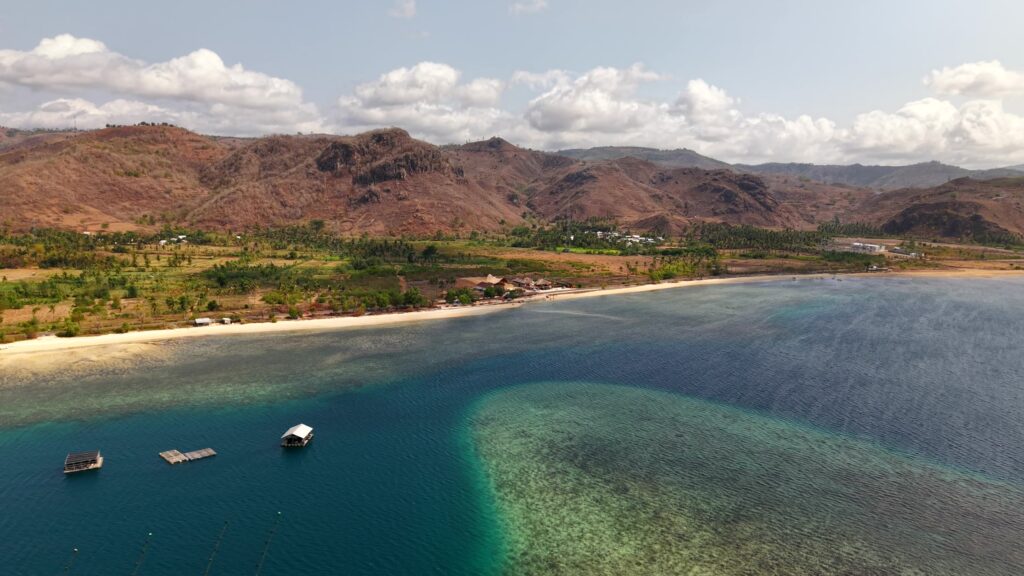
About 1 hour 10 minutes by car from Lombok International Airport. We offer a stay programme of 3 nights/4 days or more, with island trips by local boat and sunsets at SAKURA CAFE. The villas are due to be completed in stages from 2027.
Sources for this guide
- Our team’s YouTube video (published August 2025; salty shower water at beachfront accommodation)https://youtu.be/5zjh7zx5Klw
- Our team’s YouTube video (published March 2026; power lines in Sekotong)https://youtu.be/7DRBkMM1Sdk
- Our team’s YouTube channel, “Building a town in Lombok”https://www.youtube.com/@Pengembangan-Kota-di-Lombok