“Are there orangutans or Komodo dragons on Lombok?” “What animals might I see in the forest?” “Are the sharks around the Gili Islands dangerous?” These questions come up as soon as you start reading about wildlife before a trip to Lombok or the Gilis. The short answer: there are no orangutans or Komodo dragons on Lombok. In the forest you are most likely to see two kinds of monkey, deer and birds. In the sea, sea turtles are common, manta rays pass through only occasionally, and the sharks seen around the Gilis are reef sharks, which rarely attack people.
This article covers only what we could confirm as of October 2026, drawing on the official site of Mount Rinjani National Park, UNESCO, WWF, the scientific paper that described a new owl species from Lombok, the Florida Museum of Natural History’s shark profiles, Indonesian news reports and dive operators’ guides. What you see depends heavily on season, time of day and luck, so we do not claim that any place guarantees a sighting. Where something could not be confirmed, such as the current rabies situation on Lombok, we say so in that section.
It is written for travellers deciding whether to add Lombok and the Gilis to a Bali trip, families wondering whether the children will see animals, and anyone who wants to see marine life while snorkelling or diving.
As of October 2026
What this article covers
- ✓Where orangutans and Komodo dragons live, and why they are not on Lombok
- ✓How the Wallace Line shapes Lombok’s wildlife
- ✓Forest animals (monkeys, deer and birds) and where you are more likely to see them
- ✓How often you see sea turtles, mantas and sharks, and how dangerous the sharks are
- ✓Avoiding monkey and dog bites, and how to think about rabies
In short
Orangutans live only on Borneo and Sumatra, and Komodo dragons only in Komodo National Park and parts of Flores, so neither is found on Lombok. In Lombok’s forests you can see long-tailed macaques, the black leaf monkey known as lutung, deer and birds. At sea, sea turtles are common around the three Gili Islands, the sharks are mainly whitetip and blacktip reef sharks, which rarely attack people, and mantas pass through only now and then with no guarantee of a sighting. The basic rule with monkeys and dogs is to keep your distance and never feed them.
Are there orangutans or Komodo dragons on Lombok?
Neither lives on Lombok. According to WWF, orangutans live on Borneo and Sumatra. They are often named as Indonesia’s signature animal, but there are no wild orangutans on the islands further east, including Bali and Lombok.
The same goes for Komodo dragons. UNESCO’s World Heritage description says they live on Komodo, Rinca and Gili Motang, plus parts of the west and north coasts of Flores, with a population of about 5,700. Komodo National Park lies east of Lombok, between Sumbawa and Flores. From Lombok you either fly to Labuan Bajo or join a multi-day boat trip from a port in East Lombok.
Lombok’s land animals are mainly small to medium-sized, such as monkeys and deer. The mammals listed on the official Mount Rinjani National Park site do not include large animals such as tigers or elephants.
Figure: What is and is not on Lombok, at a glance
Why is wildlife different on Bali and Lombok? The Wallace Line
A boundary known as the Wallace Line runs through the Lombok Strait between Bali and Lombok. According to Encyclopaedia Britannica, it is the boundary between two zoogeographical regions, the Oriental and the Australian, proposed by the 19th-century British naturalist Alfred Russel Wallace. It passes through the Lombok Strait and continues north through the Makassar Strait between Borneo and Sulawesi. We explain the depth of the strait and the thinking behind the line with diagrams in the Lombok Strait and the Wallace Line.
The official Mount Rinjani National Park site also describes the park as lying in a transition zone where the plants and animals of Southeast Asia meet those of the Australian side. Birds are the clearest example. The site says the Sulphur Crested Cockatoo is not found west of Lombok.
There is also a bird considered endemic to Lombok: Otus jolandae, a scops owl described as a new species in the journal PLOS ONE in 2013. The paper proposed the English name Rinjani Scops Owl and the Indonesian name Celepuk Rinjani. According to the paper, it was the first endemic bird species confirmed on Lombok, and locals call it “burung pok” after its call.
It has been recorded in forest between 25m and 1,350m above sea level. On neighbouring Sumbawa, no calls were heard during a 2008 search on Mount Tambora, though the paper suggests western Sumbawa should also be surveyed. It is not confined to primary forest: its calls have also been recorded in secondary forest mixed with palms near Senggigi.
What animals can you see in the forest? Monkeys, deer, birds and Mount Rinjani National Park
Monkeys are what travellers see most easily. The official Mount Rinjani National Park site names the long-tailed macaque (locally kera) as the monkey commonly seen on Lombok, and says that in Senaru, one of the trailheads, they are often sitting on the road. The other species is the black-furred leaf monkey, the lutung. It is less common and may be seen early in the morning; the park says it is sometimes spotted in the forest around the waterfalls at Senaru.
Other forest animals listed on the same site are rusa deer (sometimes seen on trekking trails), the small barking deer or muntjac, wild boar, leopard cat, palm civet and porcupine. Many of these are nocturnal or shy, so a short stay may not be enough to see them. For birds, the site says only that “a variety of colourful birds” live there, and we could not confirm how easy each species is to spot.
If you want to see monkeys somewhere you can drive through, the forest at the Pusuk Pass on the border of West and North Lombok is well known. The environmental news site Mongabay Indonesia (2014) reported several hundred long-tailed macaques in this forest, about 30 minutes from Mataram and Senggigi, and researchers from the University of Mataram published a paper on the foraging behaviour of the macaques there in 2024. The village of Tetebatu in central Lombok also has a forest known as the Monkey Forest, where black leaf monkeys and macaques are said to be seen.
Are monkeys and dogs dangerous? Feeding and rabies
Do not approach monkeys and do not feed them. A 2014 Mongabay Indonesia article described visitors feeding monkeys at the Pusuk Pass. Assume that monkeys used to being fed may come up to you, so keep food in your bag and never spread it out in front of them. If you have children with you, an adult should stay close so they do not reach out to the animals.
Rabies is the concern if a monkey or dog bites you. A February 2019 report (tirto.id) said that in West Nusa Tenggara province 825 people had been bitten by dogs, 32 cases had tested positive for rabies and 6 people had died, but most of this was in Dompu Regency on Sumbawa (735 bites, 6 deaths). The same article said that on Lombok, 7 people in Mataram, 10 in North Lombok and 4 in East Lombok had been bitten by dogs, while the head of the provincial livestock and animal health office stated that no one on Lombok had yet been confirmed positive. detikHealth reported in the same month an Agriculture Ministry official saying there had been no human rabies cases in Mandalika.
That information is from 2019, and we could not confirm the situation on Lombok as of October 2026. Treat Indonesia as a country where rabies is present. If you are bitten or scratched, wash the wound with soap and running water for at least 15 minutes straight away, and see a doctor the same day. Ask a travel clinic before you leave whether pre-exposure vaccination makes sense for your trip.
What can you see in the sea? Turtles often, mantas sometimes
Sea turtles are the easiest marine animals to see. The Gili Trawangan dive shop Manta Dive says you will see turtles on almost every dive around the Gilis, and that Turtle Point has many hawksbill and green turtles. detikBali (March 2024) also describes dive sites around Gili Trawangan (such as Turtle Heaven) as home to hawksbills and other turtles. Both refer to diving. We cover places you can swim to from the beach and tour prices in swimming with sea turtles in the Gili Islands.
Think of a manta as a lucky bonus. The same detikBali article says mantas “sometimes pass by” Sunset Point off Gili Trawangan from December to February. Manta Dive’s guide says only that Manta Point offers mantas “when they are around”, without giving a season or odds. December to February falls in Lombok’s rainy season, when the sea can be rough on some days.
If mantas are your main goal, Nusa Penida off Bali is worth comparing. A local dive operator says mantas can be seen at Manta Point on Nusa Penida all year round, including by snorkellers (this is the operator’s own description, not independent statistics).
Figure: What you might see where on Lombok and the Gilis
Do the sharks around the Gilis attack people? Species and risk
The sharks seen around the Gili Islands are mainly whitetip reef sharks and blacktip reef sharks. Manta Dive describes Shark Point off Gili Trawangan as a place where both are often seen, and detikBali (2024) says whitetip reef sharks rest in gaps in the reef at Shark Point. These are dive sites, and we could not confirm how often snorkellers see sharks.
The Florida Museum of Natural History says whitetip reef sharks are rarely aggressive; bites on people are known, but there are no recorded deaths. They rest in caves or on the seabed by day and hunt at night. Blacktip reef sharks have bitten people swimming or wading in shallow water but are not considered a serious threat, and the International Shark Attack File (ISAF) records only 11 unprovoked bites since 1959. We found no reports of sharks attacking people around the three Gili Islands.
There are places for those who want to see bigger sharks. Belongas Bay in southwest Lombok has a rock pinnacle called “The Magnet” where hammerheads (scalloped and great hammerheads) gather. The US magazine Scuba Diving (2019) describes it as an advanced site requiring a negative entry, descending immediately without waiting at the surface. The magazine gives June to November as the season for hammerheads, but that is a general guide covering both Bali and Lombok, and we could not confirm a season specific to this site.
Caution
- Currents matter more than sharks: as our sea turtle guide explains, the currents can run fast in places around the three Gilis. If you are unsure, choose a guided tour.
- Do not feed or touch wild animals: this applies to monkeys, sharks and turtles alike. The Florida Museum of Natural History also advises against feeding wild animals.
- If bitten, see a doctor the same day: if a monkey or dog bites or scratches you, wash the wound well with soap and running water and go to a clinic that day.
A note from Sekotong
Whether you see marine life depends a great deal on the day’s tide, wind and water clarity. When you take a boat out hoping for turtles or mantas, ask the boatman or guide before leaving where visibility is good today and what the current is doing, then decide where to go. You waste less time that way. If you want to see monkeys or birds in the forest, the national park itself says they can sometimes be seen on morning and evening walks at Senaru, so building a forest walk into an early morning or late afternoon gives you more chances.
What to know before choosing Lombok for its wildlife
To be honest, Lombok is not an island where you are sure to see famous animals. There are no orangutans or Komodo dragons, the forest animals are shy, and on a short stay monkeys may be all you see. Mantas are not guaranteed even in the right season, and the places with big sharks are for advanced divers. If seeing a particular animal is the purpose of your trip, a place known for that animal, such as Borneo, Komodo National Park or Nusa Penida, is the surer choice.
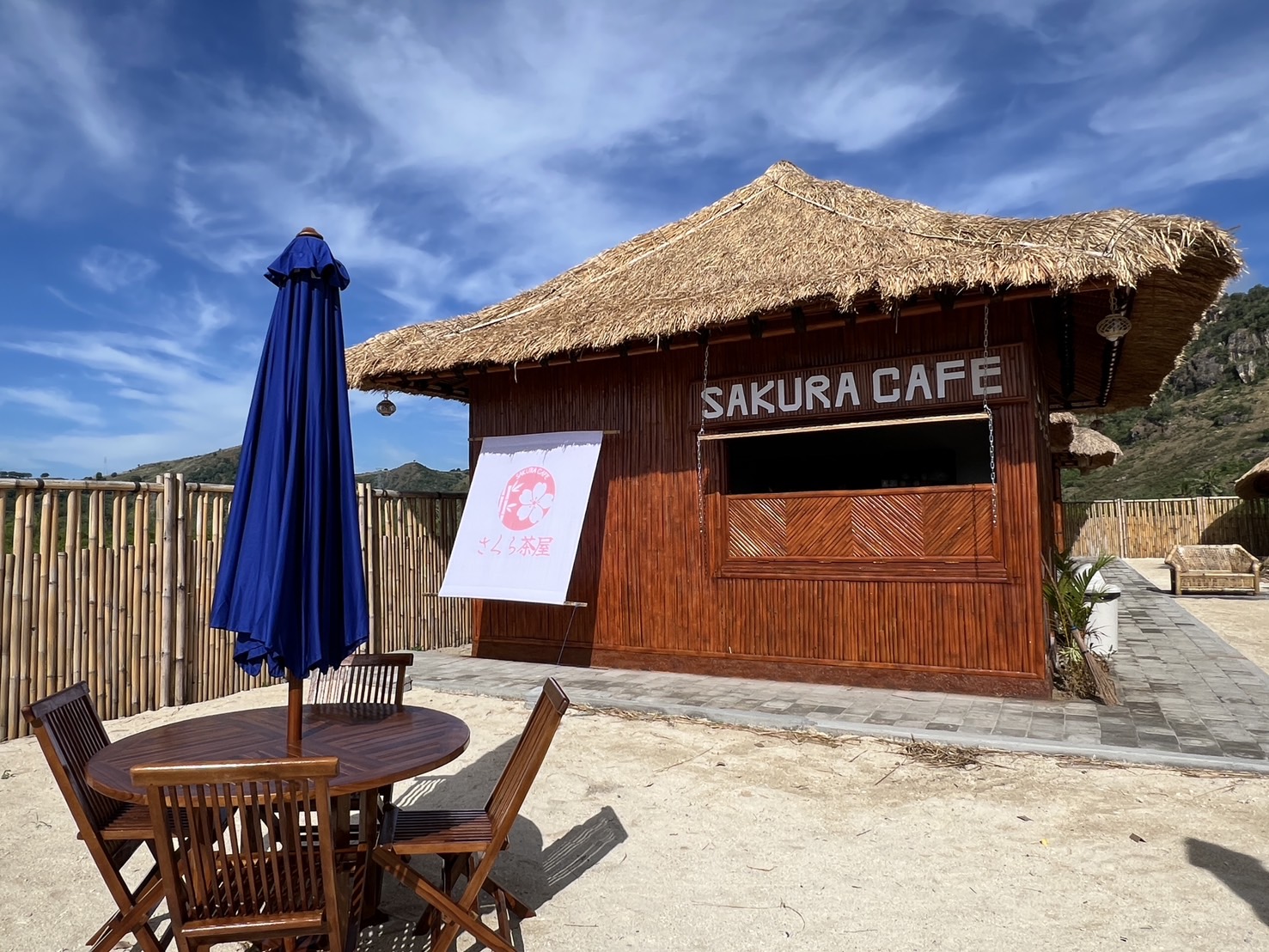
On the other hand, Lombok and the Gilis suit people who want to swim with sea turtles, walk in forests that are home to a bird found nowhere else, or feel through its wildlife that they have crossed to the east side of the Wallace Line. If you would rather avoid crowds and spend time on a quiet sea, the South Gili islands scattered off Sekotong in southwest Lombok are another option. In a fishing village in Sekotong, we run the beach cafe SAKURA CAFE (10:00 to 22:00, closed Mondays), a market and a beach club together with local Sasak people, and we take bookings for a stay programme.
Frequently asked questions
Q. Can I see orangutans on Lombok?
No. According to WWF, orangutans live on Borneo and Sumatra. The monkeys on Lombok named by Mount Rinjani National Park are two species: the long-tailed macaque and the black leaf monkey, or lutung.
Q. Can I go and see Komodo dragons from Lombok?
Yes, but they are not on Lombok, so you need to travel east to Komodo National Park. You can fly from Lombok airport to Labuan Bajo, or join a boat trip of about four days and three nights one way from a port in East Lombok.
Q. Will I see sharks while snorkelling in the Gilis?
The sharks around the Gilis are reef sharks such as whitetips and blacktips, and the places mentioned for them are mainly dive sites. The Florida Museum of Natural History says whitetip reef sharks are rarely aggressive. We found no reports of sharks attacking people around the three Gili Islands.
Q. Is there a season for mantas around Lombok?
detikBali (2024) says mantas sometimes pass Sunset Point off Gili Trawangan from December to February, but there is no guarantee. December to February is the rainy season, and the sea can be rough on some days.
Q. Are there dangerous animals such as tigers or snakes?
The mammals listed on the official Mount Rinjani National Park site do not include large animals such as tigers or elephants. For snakes, we could not find official guidance aimed at travellers. The everyday precautions for visitors are to keep away from monkeys and dogs and to watch the currents at sea.
Summary
Orangutans live only on Borneo and Sumatra, and Komodo dragons only in Komodo National Park and parts of Flores, so neither is on Lombok. Lombok lies east of the Wallace Line and has birds not seen on Bali to the west, such as the sulphur-crested cockatoo, as well as an owl (Otus jolandae) described in 2013 as endemic to Lombok. In the forest, long-tailed macaques, lutung, deer and birds are the main wildlife.
At sea, turtles are common around the three Gilis, and the sharks are mainly reef sharks that rarely attack people. Mantas pass through only occasionally. Keep away from monkeys and dogs, do not feed them, and if bitten see a doctor the same day. We could not confirm the current rabies situation on Lombok as of October 2026, so check the latest information before you travel.
Related reading
- The Wallace Line and the Lombok StraitThe “border of life” between Bali and Lombok, explained with diagrams
- Swimming with sea turtles in the Gili IslandsWhere turtles are easier to find, tour prices and distance rules
- Tetebatu guideThe village in central Lombok with rice terraces and the Monkey Forest
If you want to see Komodo dragons, they live east of Lombok in Komodo National Park. Lombok to Komodo compares the direct flight to Labuan Bajo with the four-day boat trip from east Lombok, and covers the park fee, the limit of 1,000 visitors a day since April 2026 and the months when the sea is rough.
SEMELAR BEACH VILLAGE
Come and spend some time in the Sekotong village we call home
About 1 hour 10 minutes by car from Lombok International Airport. We offer a stay programme of 3 nights/4 days or more, with island trips by local boat and sunsets at SAKURA CAFE. The villas are due to be completed in stages from 2027.
Sources for this article
- Mount Rinjani National Park (Taman Nasional Gunung Rinjani) official site, “What You Might See” (forest mammals and birds, transition zone)https://rinjaninationalpark.com/rinjani-national-park-lombok-island-indonesia/what-you-might-see/
- Mount Rinjani National Park official site, “Places of Interest” (monkeys and birds at Senaru)https://rinjaninationalpark.com/rinjani-national-park-lombok-island-indonesia/rinjani-national-park-places-of-interest/
- Sangster et al., “A New Owl Species of the Genus Otus from Lombok, Indonesia”, PLOS ONE (2013)https://pmc.ncbi.nlm.nih.gov/articles/PMC3572129
- ScienceDaily, “New owl species discovered in Indonesia” (13 February 2013)https://www.sciencedaily.com/releases/2013/02/130213173129.htm
- WWF, “Orangutan” (habitat)https://www.worldwildlife.org/species/orangutan
- UNESCO World Heritage Centre, “Komodo National Park”https://whc.unesco.org/en/list/609/
- Encyclopaedia Britannica, “Wallace Line”https://www.britannica.com/science/Wallace-Line
- Mongabay Indonesia, “Penat Terlepas di Pusuk Pass” (7 November 2014)https://mongabay.co.id/2014/11/07/mongabay-travel-penat-terlepas-di-pusuk-pass/amp/
- Aditya et al., foraging behaviour of long-tailed macaques in the Pusuk forest, Kalwedo Sains Vol. 5 No. 2 (September 2024, University of Mataram)https://ojs3.unpatti.ac.id/index.php/kalwedosains/article/view/10042
- tirto.id, “825 Warga NTB Digigit Anjing, 32 Positif Rabies, 6 Meninggal” (25 February 2019)https://tirto.id/825-warga-ntb-digigit-anjing-32-positif-rabies-6-meninggal-dhG8
- detikHealth, “Marquez dkk Tak Perlu Cemas, Mandalika Bebas Rabies” (22 February 2019)https://health.detik.com/berita-detikhealth/d-4439135/marquez-dkk-tak-perlu-cemas-mandalika-bebas-rabies
- detikBali, “6 Spot Diving di Gili Trawangan” (5 March 2024)https://www.detik.com/bali/wisata/d-7224512/6-spot-diving-di-gili-trawangan-keindahan-laut-yang-memanjakan-mata
- Manta Dive Gili Trawangan, “Gili dive sites” (dive operator’s guide)https://manta-dive.com/diving-gili-trawangan/gili-dive-sites/
- Florida Museum of Natural History, “Whitetip Reef Shark”https://www.floridamuseum.ufl.edu/discover-fish/species-profiles/whitetip-reef-shark/
- Florida Museum of Natural History, “Blacktip Reef Shark”https://www.floridamuseum.ufl.edu/discover-fish/species-profiles/blacktip-reef-shark/
- Scuba Diving, “Guide to Scuba Diving in Bali and Lombok” (21 March 2019)https://www.scubadiving.com/guide-to-scuba-diving-in-bali-and-lombok
- Nusa Penida Diving, “Pari Manta Bali” (Nusa Penida dive operator’s guide)https://nusapenida.org/id/pari-manta-bali/