What is Lombok’s history? What was the Lombok War? What happened here during the Second World War? Does the island have a World Heritage Site? Read up on Lombok or the Gili Islands before a trip and questions like these soon come up.
In short, Lombok is the island of the Sasak people. It passed through an era of Islamic kingdoms in the east, rule by a Balinese royal house from the 18th century, a Dutch military expedition in 1894 (the Lombok War) and Japanese occupation from 1942 to 1945 before becoming part of Indonesia. It opened up to tourism only from the 1980s, and was hit by major earthquakes in 2018. The island has no World Heritage Site, but the Mount Rinjani area was named a UNESCO Global Geopark in 2018.
This article is based only on sources we opened and checked ourselves: encyclopaedias, academic papers, Indonesian and international news reports, and government and UNESCO pages. Key dates were checked against at least two sources; where a date rests on a single source, or sources disagree, we name the source. For wars and the occupation, we describe only what happened.
It is written for travellers planning a trip to Lombok or the Gili Islands who want to understand how the island came to be what it is.
As of October 2026
What this article covers
- ✓Lombok’s history from the 13th century to 2018, in two timelines
- ✓The 1257 eruption of Samalas and Pamatan, the royal capital said to have been destroyed
- ✓Balinese royal rule, and what happened in the 1894 Lombok War
- ✓The Japanese occupation (1942 to 1945), the province after independence, and the start of tourism
- ✓Whether there is a World Heritage Site, and where to trace the island’s history
In short
Lombok was originally the island of the Sasak people. In 1257 the Samalas volcano, next to today’s Mount Rinjani, erupted violently, and in the late 16th century the eastern kingdom of Selaparang became Muslim. From the 18th century the royal house of Karangasem in eastern Bali ruled the island, until a Dutch expedition ended that rule in 1894. Japanese forces occupied Lombok from 1942 to 1945, and after independence it became part of West Nusa Tenggara province in 1958. The island has no World Heritage Site, but the Mount Rinjani area was named a UNESCO Global Geopark in 2018.
What does Lombok’s history look like as a timeline?
Lombok’s history is easiest to follow in four stages: the era of Sasak kingdoms, Balinese royal rule from the 18th century, Dutch rule from 1894 and Japanese rule from 1942, and the period after independence. First, the years before independence.
Figure: Lombok before independence (13th century to 1894)
From around independence to the present day, the story runs as follows. As a tourist destination, Lombok’s history is short.
Figure: From independence to today (1942 to 2018)
Who are the Sasak, and what was the era of the first kingdoms like?
Most people on Lombok are Sasak. Encyclopaedia Britannica describes the Sasak as a Malay people who were originally the island’s only inhabitants. They speak Sasak, which belongs to the Austronesian language family along with Balinese and others. We could not find any source that clearly shows where or when they came from.
The island first appears in writing in the 14th century. The poem Nagarakretagama, written in 1365 in the Majapahit kingdom on Java, mentions Lombok and the Sasak, and a 2019 paper in a journal published by Indonesia’s language agency, among others, explains that the area fell within Majapahit’s sphere of influence.
There are three theories about when Islam arrived: the 13th to 14th centuries, the late 16th to early 17th centuries, and the 16th century (tirto.id, 2023). According to the same article, the eastern kingdom of Selaparang became Muslim in the late 16th century, grew into a powerful kingdom and fell in the 18th century. Britannica says that by 1640 the island was already under the rule of the Sultan of Makassar on Sulawesi.
Before this era, one event changed the island’s history profoundly: the eruption of the Samalas volcano in 1257. Samalas, part of the same volcanic complex as today’s Mount Rinjani, erupted violently and then collapsed, leaving a huge basin (a caldera). Today’s Segara Anak lake lies inside this caldera (Good News From Indonesia, 2026).
In 2013 a team of French and Indonesian researchers published a paper in the US journal PNAS identifying Samalas as the volcano behind the great 1257 eruption, whose source had long been unknown (The Conversation, Good News From Indonesia). One of their clues was the Babad Lombok, a record written in old Javanese on palm leaves. It says the eruption destroyed Pamatan, the royal capital of the time.
According to Eos, published by the American Geophysical Union (2022), the site of Pamatan has not yet been found. The babad mixes legend with fact, and is thought to have been compiled in the 18th or 19th century, several hundred years after the eruption.
When and how did the Balinese royal house come to rule Lombok?
In the 18th century, the royal house of Karangasem in eastern Bali extended its power from western Lombok and came to rule the island. Sources differ on when this began, though. Good News From Indonesia (2022) says the king of Karangasem defeated Selaparang in 1675; tirto.id (2023) says Selaparang lost a war against combined Balinese and Sumbawan forces in 1723; and English Wikipedia gives 1740. Britannica says “from the 18th century”.
According to Britannica, the Balinese established four kingdoms on the island, and one of them, Mataram, held a treaty with the Dutch from 1843 to 1872. English Wikipedia says the Mataram royal house came to rule the whole island around 1838 to 1839 (different articles give 1838 or 1839). The palaces stood at Mataram and Cakranegara, both within today’s city of Mataram.
Buildings from this period still stand in Mataram. Pura Meru, the largest Hindu temple on Lombok, was built in the 18th century according to the Indonesian tourism authority, and in 1720 according to CNN Indonesia (2018). The nearby Mayura garden dates from 1744 according to CNN Indonesia and from 1866 according to English Wikipedia, so its date is uncertain.
What happened in the 1894 Lombok War?
The Lombok War was a campaign in 1894 in which the army of the Dutch East Indies sent an expedition to Lombok and ended the rule of the Balinese royal house. Britannica explains that the Mataram court’s oppression of the Sasak and its meddling in Balinese politics led to Dutch intervention.
According to an account by the Dutch researcher Dirk Teeuwen and English Wikipedia, the Sasak rose up against the royal house in 1891, and fighting with the royal army dragged on. Sasak chiefs asked the Dutch for help, and in 1894 Dutch troops landed near Ampenan.
The same two sources say that on the night of 25 August 1894, the Dutch camp at Cakranegara was attacked by the royal side. The expedition’s commander, Major General van Ham, was killed, and the army fell back for a time. Figures for Dutch deaths vary widely between sources, so we do not give them here.
Reinforced, the Dutch resumed the attack, advancing on Mataram from the end of September and taking the palace at Cakranegara in November. The elderly king was sent with his family to Batavia (today’s Jakarta), where he died in May 1895. According to Britannica, this ended Balinese rule, and Lombok came under direct Dutch control.
The gold and silver objects taken from the palace at this time became known as the “Lombok Treasure”. The Rijksmuseum in Amsterdam describes them as having been taken by the Royal Netherlands East Indies Army (KNIL) in 1894. In July 2023 the Dutch government announced it would return the treasure to Indonesia (The Jakarta Post), and it was returned that same year (Rijksmuseum).
Caution
- Dates sometimes differ between sources: the start of Balinese rule (1675, 1723 or 1740) and the date of the Mayura garden vary by source. If a guide’s explanation or a sign on site disagrees, that does not necessarily mean either one is wrong.
- Where to see the returned treasure: we could not confirm where the “Lombok Treasure” returned in 2023 is currently on display. If you want to see it, contact the museum before you visit.
What was Lombok like under Japanese occupation (1942 to 1945)?
Indonesia was occupied by the Japanese military from 1942 to 1945; the Netherlands Indies government surrendered on 9 March 1942 (US Library of Congress country study). According to a report by Michio Haga of Japan’s National Institute for Defense Studies, the army administered Java and Sumatra, while the navy administered areas including the Lesser Sunda Islands. Lombok is one of the Lesser Sunda Islands.
A 2023 paper in the Indonesian journal Humanitas says Japanese forces landed at Labuhan Haji in eastern Lombok on 12 May 1942, beginning the occupation of the island. English Wikipedia says a fleet entered Ampenan harbour on 9 March that year; sources describe the date and place of the landing differently.
According to the same paper, during the occupation local people were conscripted for forced labour (romusha) and crops were requisitioned. The administrative system also changed: the Indonesian news site detikBali reports that West Lombok became an administrative unit called a “bunken”. On Gili Trawangan, English Wikipedia says a lookout post and a prisoner-of-war camp were set up, and The Jakarta Post (2012) quotes residents who say the name Trawangan means “tunnel” in Sasak and refers to defensive tunnels the Japanese dug on the island in the 1940s.
How did Lombok become what it is today after independence?
After Japan’s surrender, Sukarno and Hatta declared Indonesian independence on 17 August 1945 (US Library of Congress country study). Dutch power returned to Lombok, and according to the Humanitas paper the island became part of the State of East Indonesia (Negara Indonesia Timur), founded on 24 December 1946. In 1949, under the Hague agreement, the Netherlands recognised Indonesian independence, ending the war of independence against the Dutch; sovereignty was formally transferred on 27 December 1949 after the Round Table Conference in The Hague (US Library of Congress country study).
The present province took shape in 1958. A law passed in August 1958 (Law No. 64 of 1958) created three provinces: Bali, West Nusa Tenggara and East Nusa Tenggara (legal database of the Indonesian Audit Board). Lombok became part of West Nusa Tenggara together with Sumbawa to the east, with Mataram as the provincial capital.
English Wikipedia says tourism development began in the mid-1980s. A major milestone came on 1 October 2011, when Lombok International Airport opened in the centre of the island, replacing Selaparang Airport in Mataram (detikNews, ANTARA). In 2014 Mandalika in the south was designated a special economic zone for tourism (Directorate General of Taxes, Republika), and in 2022 the Mandalika circuit hosted its first MotoGP race (the second was in 2023; Republika).
2018 was a momentous year for the island. In April the Mount Rinjani area was recognised as a UNESCO Global Geopark (ANTARA, Republika), and three months later came a series of major earthquakes. According to ReliefWeb, the UN humanitarian information service, a magnitude 6.4 earthquake struck on 29 July and a magnitude 7.0 earthquake on 5 August, followed by another strong quake on 19 August. Indonesia’s National Disaster Management Agency (BNPB) counted 564 deaths across the series, and over 400,000 people were displaced. What travellers should know is covered in our article on earthquakes and tsunamis in Lombok.
What is the history of the Gili Islands?
Gili Trawangan, Gili Meno and Gili Air have only a short history of human settlement. A 2023 paper by researchers at Gadjah Mada University says people have lived on Gili Trawangan since the 1970s. English Wikipedia says a lack of fresh water delayed settlement, and that in 1971 the then governor opened coconut plantations there.
Travellers began arriving in the 1980s, when backpackers came over as tourism spread on neighbouring Bali (English Wikipedia). In 2011 Gili Trawangan was designated a national tourism strategic area (KSPN) (same paper).
Does Lombok have a World Heritage Site? Where can you trace its history?
Lombok has no World Heritage Site. As of October 2026, the UNESCO World Heritage Centre page for Indonesia lists 10 World Heritage Sites and 21 sites on the Tentative List, none of them in West Nusa Tenggara, the province that includes Lombok. The nearest World Heritage Site is Komodo National Park (inscribed in 1991).
What is often confused with World Heritage status is the UNESCO Global Geopark designation of 2018. It is a separate UNESCO programme, and it covers the Mount Rinjani area. The caldera formed by the 1257 eruption and Segara Anak lake lie within Mount Rinjani National Park.
The table below lists places where you can see the island’s history for yourself.
← Scroll the table sideways
| Place | What it tells you, and from which era | What we could confirm |
|---|---|---|
| West Nusa Tenggara State Museum (Mataram) | Geology, archaeology, ethnography and history. A geology hall covers Mount Rinjani | Permanent exhibition under renovation for about four months from August 2026. Open during the work (report of July 2026) |
| Pura Meru (Cakranegara) | The island’s largest Hindu temple, built during Balinese royal rule | Built in the 18th century (tourism authority). Still a place of worship |
| Mayura garden (Cakranegara) | A garden of the Balinese royal house, and a site of fighting in 1894 | Date differs by source (a news report says 1744, another source says 1866) |
| Segara Anak lake (Mount Rinjani) | A lake in the caldera formed by the 1257 Samalas eruption | Reaching the lake requires a trek. Entry conditions change with the season |
Note: based on the sources listed at the end of this article, as of October 2026. Opening hours and visiting conditions may change.
According to the Indonesian tourism authority’s page (no publication date given; online as of October 2026), the state museum is at Jalan Panji Tilar Negara No. 6 in Mataram. It opens Monday 10:00 to 16:00, Tuesday to Thursday 8:00 to 16:00, Friday 8:00 to 17:00 and Saturday and Sunday 8:00 to 13:00, and closes on public holidays. Admission for foreign visitors is Rp7,000 (about US$0.40). However, the radio network RRI (July 2026) reports that the permanent exhibition is being renovated, with exhibits moved to a temporary gallery, and completion is targeted for 17 December 2026. Check the opening hours and what is on display before you go.
A note from Sekotong
When touring the temples and gardens of Mataram, avoid the Friday midday prayer time and book your car by the day before with a specific pick-up time; it makes the day much easier. At temples, check the dress code and which areas you may enter at the entrance, and refrain from taking photos during ceremonies. Explanations of dates and origins can vary from guide to guide. If something puzzles you, ask which source the explanation is based on; that often reveals why accounts differ.
Is Lombok a good destination for exploring history?
The drawbacks first. Lombok has no World Heritage Site, and it does not suit a trip built around major monuments like Borobudur on Java. There are few places that tell the island’s story, and as of October 2026 the state museum’s permanent exhibition is under renovation. If historical sightseeing is the centre of your trip, Java or Bali will suit you better.
On the other hand, if you want to spend time by the sea or in the mountains and are curious about Sasak life and an island where Islam and Hinduism sit side by side, Lombok suits you well. In Mataram you can see temples and gardens from the era of Balinese royal rule, and if you climb Mount Rinjani you can see with your own eyes the lake created by the 1257 eruption.
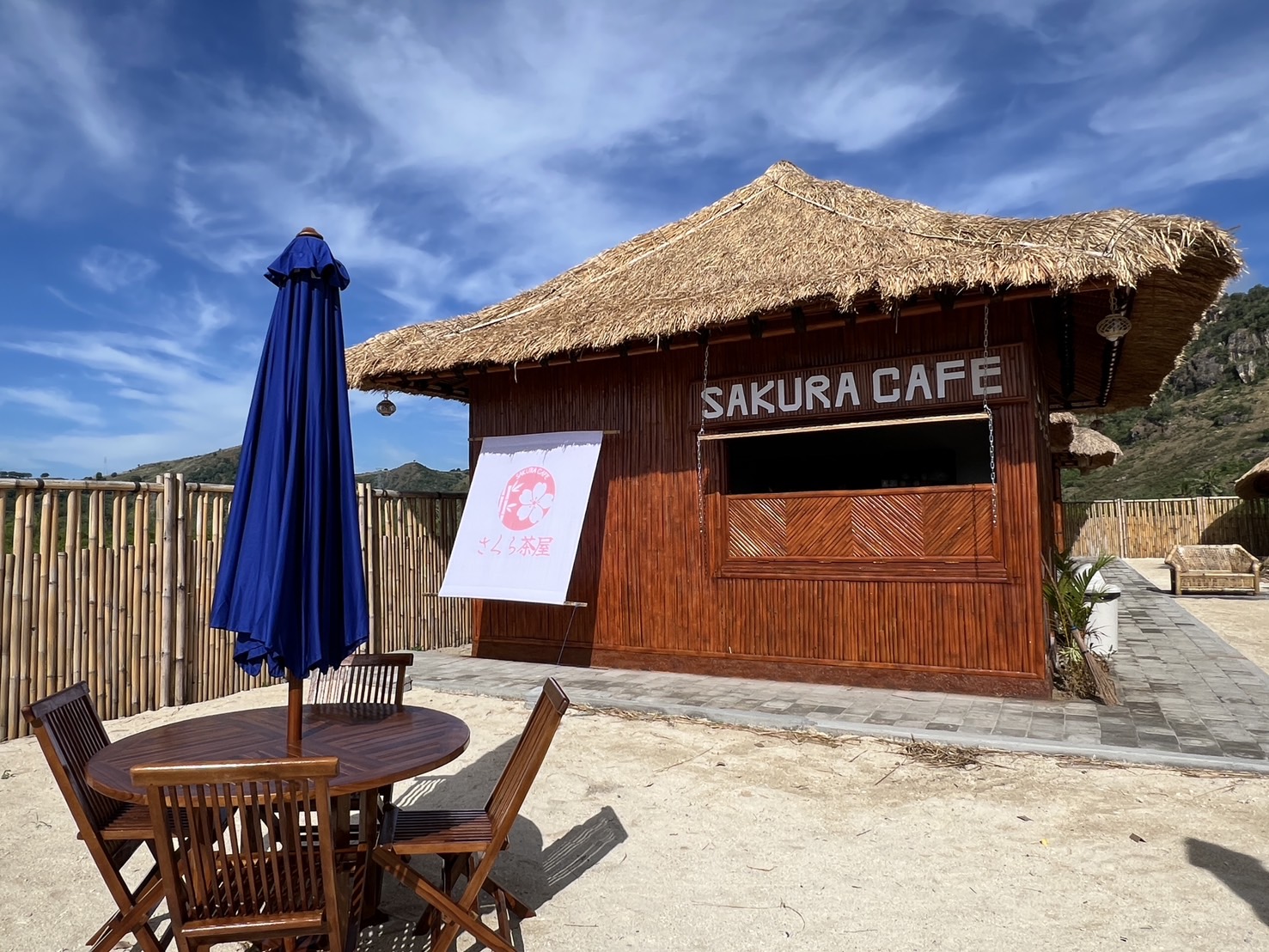
Sekotong in the southwest is a fishing area where local Sasak families live. Semelar Beach Village is in this village, where we run a beach cafe (SAKURA CAFE, 10:00 to 22:00, closed Mondays), a market and a beach club together with local Sasak people. What you can book now is a stay programme of 3 nights and 4 days to 5 nights and 6 days.
Frequently asked questions
Q. Does Lombok have a World Heritage Site?
No. As of October 2026, no site in West Nusa Tenggara, the province that includes Lombok, is on UNESCO’s World Heritage List or Tentative List. The Mount Rinjani area was named a UNESCO Global Geopark in 2018, but that is a separate programme from World Heritage.
Q. What was the Lombok War?
It was a campaign in 1894 in which the army of the Dutch East Indies sent an expedition to Lombok and ended the rule of the Balinese royal house that governed the island. It was triggered by a Sasak uprising that began in 1891, and the palace at Cakranegara fell in November.
Q. What happened on Lombok during the Second World War?
From 1942 to 1945, Indonesia, including Lombok, was occupied by the Japanese military. An Indonesian paper says that on Lombok, too, residents were conscripted for labour and crops were requisitioned.
Q. Do the Gili Islands have a long history?
Their history of settlement is short; Gili Trawangan is said to have been settled from the 1970s, and travellers began arriving in the 1980s. Some sources say a lookout post was set up there during the Japanese occupation, and residents say the island’s name comes from Japanese defensive tunnels.
Summary
Lombok is the island of the Sasak people. After the 1257 eruption of Samalas, the conversion of the Selaparang kingdom to Islam in the late 16th century, Balinese royal rule from the 18th century, the Dutch expedition of 1894 and Japanese occupation from 1942 to 1945, it became part of West Nusa Tenggara province in 1958, after independence. Its history as a tourist destination dates from the 1980s; a new airport opened in 2011, and major earthquakes struck in 2018.
The island has no World Heritage Site; the Mount Rinjani area is a UNESCO Global Geopark. Places to trace its history are concentrated in Mataram’s temples and gardens and the state museum. Keep in mind that dates can differ from one source to another.
Related reading
- The Sasak people and traditional villagesSasak daily life, and how to visit a traditional village
- Senggigi vs. MataramHow to spend time in Mataram, the provincial capital with its temples and gardens
- Mount Rinjani trekking guidePermits, costs and itineraries for the trek to the lake formed by the eruption
SEMELAR BEACH VILLAGE
Come and spend some time in the Sekotong village we call home
About 1 hour 10 minutes by car from Lombok International Airport. We offer a stay programme of 3 nights/4 days or more, with island trips by local boat and sunsets at SAKURA CAFE. The villas are due to be completed in stages from 2027.
Sources for this article
- Encyclopaedia Britannica, “Lombok”https://www.britannica.com/place/Lombok
- Encyclopaedia Britannica, “Sasak”https://www.britannica.com/topic/Sasak
- The Conversation, “Indonesia’s Samalas volcano may have kickstarted the Little Ice Age” (2013)https://theconversation.com/indonesias-samalas-volcano-may-have-kickstarted-the-little-ice-age-18772
- Eos (American Geophysical Union), “Stories Scribed on Palm Leaves Help Scientists Understand Ancient Eruption” (19 December 2022)https://eos.org/articles/stories-scribed-on-palm-leaves-help-scientists-understand-ancient-eruption
- Good News From Indonesia, “Penemuan Gunung Samalas” (28 July 2026)https://www.goodnewsfromindonesia.id/2026/07/28/penemuan-gunung-samalas-kisah-ekspedisi-ilmiah-prancis-mengungkap-gunung-berapi-terdahsyat-di-lombok
- Abdullah Maulani, “Merak, Ikan, dan Singandarung”, Jentera 8(2) (2019; the Nagarakretagama of 1365 and Lombok)https://ojs.badanbahasa.kemdikbud.go.id/jurnal/index.php/jentera/article/download/1524/1004
- tirto.id, “Pemakaman Kuno Selaparang, Jejak Kerajaan Islam di Pulau Lombok” (13 April 2023)https://tirto.id/pemakaman-kuno-selaparang-jejak-kerajaan-islam-di-pulau-lombok-gEMs
- Good News From Indonesia, “Tradisi Hindu dan Kilas Balik Kedatangan Migran Bali ke Pulau Lombok” (4 March 2022)https://www.goodnewsfromindonesia.id/2022/03/04/tradisi-hindu-dan-kilas-balik-kedatangan-migran-bali-ke-pulau-lombok
- Wikipedia (English), “Kingdom of Karangasem” (supplementary)https://en.wikipedia.org/wiki/Kingdom_of_Karangasem
- Wikipedia (English), “Dutch intervention in Lombok and Karangasem” (supplementary)https://en.wikipedia.org/wiki/Dutch_intervention_in_Lombok_and_Karangasem
- Dirk Teeuwen, “Lombok Expedition 1894”https://www.indonesia-dutchcolonialheritage.nl/lombokhistory/Lombok.pdf
- Indonesian tourism authority, “Pura Meru Cakranegara”https://www.indonesia.travel/gb-en/destination/bali-nusa-tenggara/west-nusa-tenggara/pura-meru-cakranegara/
- CNN Indonesia, “Destinasi Wisata Mataram Siap Sambut Obor Asian Games” (22 July 2018)https://www.cnnindonesia.com/gaya-hidup/20180722170317-269-316105/destinasi-wisata-mataram-siap-sambut-obor-asian-games
- Wikipedia (English), “Mayura Park” (supplementary)https://en.wikipedia.org/wiki/Mayura_Park
- The Jakarta Post, “Dutch to return colonial treasures to Indonesia, Sri Lanka” (6 July 2023)https://www.thejakartapost.com/world/2023/07/06/dutch-to-return-colonial-treasures-to-indonesia-sri-lanka.html
- Rijksmuseum, Amsterdam, “Exhibiting colonialism”https://www.rijksmuseum.nl/en/research/our-research/overarching/provenance-research-colonial-collections/exhibiting-colonialism
- US Library of Congress, Country Studies “Indonesia: The Japanese Occupation, 1942-45”https://countrystudies.us/indonesia/15.htm
- US Library of Congress, Country Studies “Indonesia: The National Revolution, 1945-50”https://countrystudies.us/indonesia/16.htm
- Michio Haga, “The reality of Japanese military administration in Indonesia”, National Institute for Defense Studies, Japan (Japanese)https://www.nids.mod.go.jp/event/proceedings/forum/pdf/2007/forum_j2007_06.pdf
- Wijaya et al., “The Struggle of TGH Mahsun in Fighting for Independence in East Lombok, 1942-1946”, Jurnal Humanitas 9(2) (2023)https://e-journal.hamzanwadi.ac.id/index.php/jhm/article/download/36556/8836/215283
- detikBali, “Sejarah Singkat Kabupaten Lombok Barat”https://www.detik.com/bali/nusra/d-6910822/sejarah-singkat-kabupaten-lombok-barat
- The Jakarta Post, “Gili Trawangan: A hidden paradise” (18 March 2012)https://www.thejakartapost.com/news/2012/03/18/gili-trawangan-a-hidden-paradise
- Indonesian Audit Board legal database, “UU No. 64 Tahun 1958”https://peraturan.bpk.go.id/Details/52333
- Wikipedia (English), “Lombok” (supplementary)https://en.wikipedia.org/wiki/Lombok
- Wikipedia (English), “Gili Islands” (supplementary)https://en.wikipedia.org/wiki/Gili_Islands
- Fitria and Setiawan, “Pola Perilaku Wisatawan di Pulau Kecil: Gili Trawangan, Lombok” (2023, Gadjah Mada University)https://journal.uib.ac.id/index.php/jad/article/download/7670/3214
- detikNews, “Bandara International Lombok Resmi Gantikan Selaparang” (1 October 2011)https://news.detik.com/berita/d-1734609/bandara-international-lombok-resmi-gantikan-selaparang
- ANTARA, “Bandara Selaparang Ditutup Mulai 1 Oktober” (19 August 2011)https://www.antaranews.com/berita/272445/bandara-selaparang-ditutup-mulai-1-oktober
- Directorate General of Taxes, Indonesia, “Melihat Sisi Lain Sirkuit Mandalika” (14 February 2022)https://www.pajak.go.id/id/artikel/melihat-sisi-lain-sirkuit-mandalika
- Republika, “ITDC Sebut KEK Mandalika Terus Dikembangkan” (3 October 2023)https://ekonomi.republika.co.id/berita/s1y92m457/itdc-sebut-kek-mandalika-terus-dikembangkan
- ANTARA English, “UNESCO designates Mount Rinjani as global geopark” (14 April 2018)https://en.antaranews.com/news/115351/unesco-designates-mount-rinjani-as-global-geopark
- Republika, “Unesco Tetapkan Rinjani Jadi Geopark Dunia” (15 April 2018)https://news.republika.co.id/berita/p786ef384/unesco-tetapkan-rinjani-jadi-geopark-dunia
- ReliefWeb (UN Office for the Coordination of Humanitarian Affairs), “Indonesia: Earthquakes – Jul 2018”https://reliefweb.int/disaster/EQ-2018-000122-IDN
- Tempo English, “BNPB: Lombok Quake Recovery Costs Rise to Rp2.6tn” (September 2018; BNPB recorded at least 564 deaths, more than 80% in North Lombok)https://en.tempo.co/amp/921537/bnpb-lombok-quake-recovery-costs-rise-to-rp2-6tn
- UNESCO World Heritage Centre, “Indonesia”https://whc.unesco.org/en/statesparties/id
- Indonesian tourism authority, “Museum Negeri Nusa Tenggara Barat”https://www.indonesia.travel/us-en/destination/bali-nusa-tenggara/west-nusa-tenggara/museum-negeri-nusa-tenggara-barat
- RRI, “Permanent Exhibition Space at NTB Museum Revitalizes After 16 years” (14 July 2026)https://rri.co.id/en/archipelago/2566028/permanent-exhibition-space-at-ntb-museum-revitalizes-after-16-years