How many World Heritage Sites does Indonesia have, where are they, and is there one on Lombok? These are good questions to start with when you plan where to go in Indonesia.
In short: Indonesia has ten World Heritage Sites. Six are cultural (Borobudur Temple Compounds, Prambanan Temple Compounds, Sangiran Early Man Site, the subak landscape of Bali, the Ombilin Coal Mining Heritage of Sawahlunto, and the Cosmological Axis of Yogyakarta) and four are natural (Ujung Kulon, Komodo and Lorentz National Parks, and the Tropical Rainforest Heritage of Sumatra). Lombok has no World Heritage Site, but the area around Mount Rinjani is a UNESCO Global Geopark.
This article is based on UNESCO World Heritage Centre’s list for Indonesia and English Wikipedia’s list of World Heritage Sites in Indonesia, read in October 2026. It is written for travellers who want to visit heritage sites in Indonesia and for those looking for sites to combine with a trip to Lombok.
Information as of October 2026
What this article covers
- ✓The names, locations and years of Indonesia’s ten World Heritage Sites
- ✓The cultural and natural sites, and the one on the danger list
- ✓Which islands they are on
- ✓Sites on the Tentative List
- ✓Whether Lombok has a World Heritage Site, and which sites are close
In short
Indonesia has ten World Heritage Sites: six cultural and four natural. Half are on Java, and the rest are on Bali, Sumatra, in East Nusa Tenggara (Komodo) and in Papua. Lombok has none, but the Mount Rinjani area is a UNESCO Global Geopark. From Lombok, Bali’s subak and Komodo National Park are close, and there are direct flights to Yogyakarta for Borobudur and Prambanan (as of October 2026).
How many World Heritage Sites does Indonesia have?
UNESCO World Heritage Centre lists the following ten sites for Indonesia. Four were inscribed together in 1991, and the most recent is the Cosmological Axis of Yogyakarta and its Historic Landmarks, inscribed in 2023. The sources opened for this article showed no inscriptions after 2023.
← Scroll sideways to see the whole table
| Site | Location | Type | Inscribed |
|---|---|---|---|
| Borobudur Temple Compounds | Central Java | Cultural | 1991 |
| Prambanan Temple Compounds | Central Java and Yogyakarta | Cultural | 1991 |
| Ujung Kulon National Park | Banten and Lampung | Natural | 1991 |
| Komodo National Park | East Nusa Tenggara | Natural | 1991 |
| Sangiran Early Man Site | Central Java | Cultural | 1996 |
| Lorentz National Park | Papua | Natural | 1999 |
| Tropical Rainforest Heritage of Sumatra | Aceh, Jambi, Lampung and others | Natural (in danger) | 2004 |
| Cultural Landscape of Bali Province: the Subak System | Bali | Cultural | 2012 |
| Ombilin Coal Mining Heritage of Sawahlunto | West Sumatra | Cultural | 2019 |
| Cosmological Axis of Yogyakarta and its Historic Landmarks | Yogyakarta | Cultural | 2023 |
Sources: list and years from UNESCO World Heritage Centre; location, type and danger status from English Wikipedia.
By type, six are cultural and four natural. The cultural sites range across Buddhist and Hindu temples, a landscape rich in early human fossils, a system for sharing water between rice fields, a colonial coal mine and the axis of a royal city. The natural sites are national parks that protect forests and seas and species found nowhere else, such as the Javan rhinoceros and the Komodo dragon.
Which islands are the sites on?
Five of the ten are on Java, two on Sumatra (the rainforest and the Ombilin mine), and one each on Bali, in East Nusa Tenggara (Komodo) and in Papua. West Nusa Tenggara, the province that includes Lombok, has none.
Figure: Where Indonesia’s ten World Heritage Sites are
What are the six cultural sites like?
Borobudur Temple Compounds are an 8th to 9th century Buddhist monument: tiered terraces topped by a large stupa and surrounded by 72 smaller stupas, restored with UNESCO’s help in the 1970s. Prambanan Temple Compounds are a 10th-century Hindu complex dedicated to Shiva, Vishnu and Brahma, with reliefs of the Ramayana (English Wikipedia).
Sangiran Early Man Site is where important hominid fossils, including Homo erectus, were found, and it is a key place for the study of human evolution. Bali’s subak is a system that links rice terraces and water temples to share water, dating back to the 9th century. The Ombilin mine is a late 19th to early 20th century colonial coal mine, listed together with its mining town, railway and port. The Yogyakarta axis is a line of about 6 km from Mount Merapi in the north to the Indian Ocean in the south, centred on the 18th-century royal palace (kraton).
← Scroll sideways to see the whole table
| Site | What you see |
|---|---|
| Borobudur | 8th to 9th century Buddhist monument with terraces and 72 small stupas |
| Prambanan | 10th-century Hindu temples with Ramayana reliefs |
| Sangiran | Landscape where early human fossils were found |
| Bali’s subak | Rice terraces and water temples sharing water |
| Ombilin | Colonial coal mine with railway, port and mining town |
| Yogyakarta axis | About 6 km from Merapi to the ocean, centred on the palace |
Source: summarised from English Wikipedia’s list of World Heritage Sites in Indonesia.
The four natural sites, and the site in danger
Ujung Kulon National Park covers the peninsula at the western tip of Java and the Krakatoa caldera, with large areas of lowland rainforest and the Javan rhinoceros. Komodo National Park is home to around 5,700 Komodo dragons, along with savannah, beaches and coral reefs. Lorentz National Park, at about 2.35 million hectares, is the largest World Heritage Site in Southeast Asia, stretching from snow-capped peaks to tropical seas (English Wikipedia).
The Tropical Rainforest Heritage of Sumatra is made up of three national parks that are home to the Sumatran orangutan, among others. It has been on the List of World Heritage in Danger since 2011, with poaching, illegal logging, encroachment by farmland and planned roads among the threats. When you visit, follow park rules and go with a licensed guide.
Take care
- Entrance fees and visiting rules can change. Check the managing body’s information before you go
- Climbing Borobudur’s structure is limited to a set number of visitors and is reported to sell out, so book early
- In natural sites, walk with a licensed guide and stay on marked trails
- At temples and palaces, cover your shoulders and knees
Which sites might be next? The Tentative List
English Wikipedia lists 21 sites on Indonesia’s Tentative List, including the Majapahit capital at Trowulan in East Java, the Muarajambi temple compound in Jambi, the Banda Islands in Maluku, Raja Ampat in West Papua, the Old Town of Jakarta, the Old Town of Semarang, Tana Toraja, and Wakatobi and Bunaken National Parks. No places on Lombok, Bali or elsewhere in Nusa Tenggara appear among the notable entries. Being on the Tentative List does not guarantee inscription, which follows a formal evaluation.
Is there a World Heritage Site on Lombok? Sites you can reach from Lombok
Lombok has no World Heritage Site. However, UNESCO’s executive board named Rinjani a UNESCO Global Geopark on 13 April 2018 (ANTARA). A geopark is a different programme from World Heritage: it recognises an area’s landforms, geology and local culture and supports their protection, education and tourism. Our article on the Rinjani-Lombok UNESCO Global Geopark explains more.
Three World Heritage Sites are easy to reach from Lombok. Komodo National Park lies to the east and can be reached by air or on a multi-day boat trip. Bali’s subak landscape, to the west, fits into a trip that also takes in Bali. And for Borobudur and Prambanan, trip.com lists direct flights from Lombok to Yogyakarta International Airport (October 2026), taking about 1 hour 30 minutes.
← Scroll sideways to see the whole table
| From Lombok to | How to get there |
|---|---|
| Komodo National Park | Fly to Labuan Bajo, or take a multi-day boat trip |
| Bali’s subak | Fly or take a ferry or fast boat to Bali |
| Borobudur and Prambanan | Direct flight to Yogyakarta, about 1 hr 30 min |
Yogyakarta flights from trip.com (October 2026). Other routes from our travel guides.
A note from Sekotong
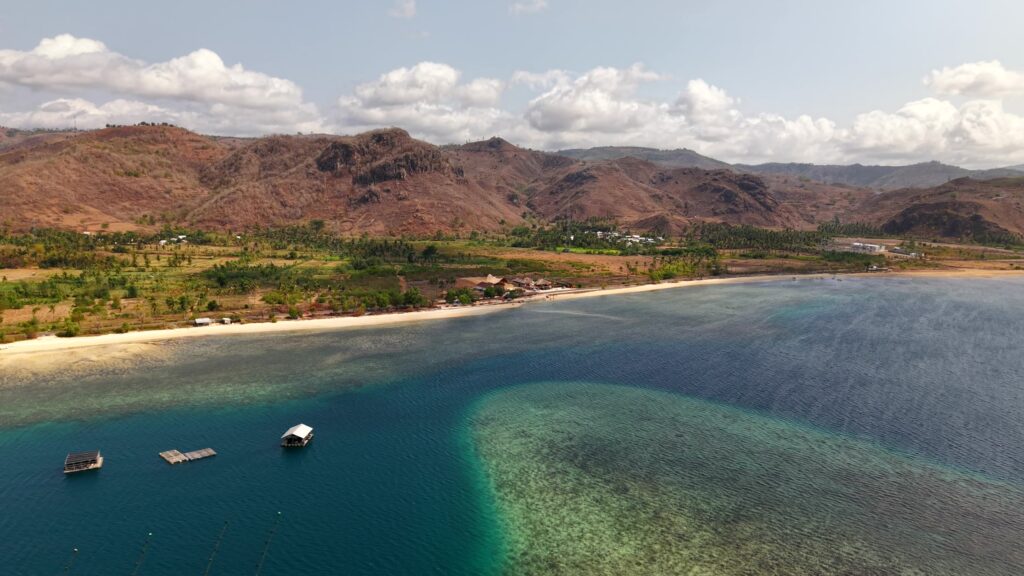
Sekotong in south-west Lombok is not a World Heritage Site, but it has the sea around the small islands of the Southern Gilis and fishing villages where everyday life carries on. It can be a quiet place for a few days without much travel in between heritage visits. See getting from Bali to Sekotong for the routes.
Downsides of a heritage-focused trip, and who it suits
First the downsides. Indonesia’s heritage sites are spread across many islands, so trying to see several in one trip means a lot of flying. Popular sites get crowded, and some visits, such as climbing Borobudur, are limited in number. Many natural sites are remote, and Lorentz National Park or the Sumatran rainforest are not places you can drop into easily.
On the other hand, if you focus on one or two sites and spend longer on each island, you can get to know the temples or forests in depth. Pairing nearby places, such as Java’s temples with Bali’s rice terraces, or Komodo’s seas with Lombok, keeps travel time down.
Frequently asked questions
Q. How many World Heritage Sites does Indonesia have?
Ten: six cultural and four natural, according to UNESCO’s list as checked in October 2026.
Q. Which is the newest?
The Cosmological Axis of Yogyakarta and its Historic Landmarks, inscribed in 2023.
Q. Is there a World Heritage Site on Lombok?
No. The Mount Rinjani area was named a UNESCO Global Geopark in 2018.
Q. Is any Indonesian site on the danger list?
Yes, the Tropical Rainforest Heritage of Sumatra has been on the List of World Heritage in Danger since 2011.
Q. Which sites are easiest to reach from Lombok?
Komodo National Park to the east and Bali’s subak to the west. There are also direct flights from Lombok to Yogyakarta for Borobudur and Prambanan.
Summary
Indonesia has ten World Heritage Sites, six cultural and four natural. Half are on Java, and the rest are on Sumatra, Bali, in East Nusa Tenggara and in Papua. The Sumatran rainforest is on the danger list, and 21 sites are on the Tentative List.
Lombok has no World Heritage Site, but the Rinjani area is a UNESCO Global Geopark. Komodo National Park, Bali’s subak and the temples near Yogyakarta are the easiest sites to combine with a Lombok trip (as of October 2026).
Related reading
- Rinjani-Lombok UNESCO Global GeoparkThe UNESCO status and how to visit the geosites
- Islands next to BaliHow Nusa Penida, Lembongan, the Gilis and Lombok differ
- Lombok island guideGetting there, weather and what to see
More on this topic: Indonesia Travel Basics. Adding three nights on Lombok to a Bali trip: Stay Programme Itineraries.
SEMELAR BEACH VILLAGE
Come and spend some time in the Sekotong village we call home
About 1 hour 10 minutes by car from Lombok International Airport. We offer a stay programme of 3 nights/4 days or more, with island trips by local boat and sunsets at SAKURA CAFE. The villas are due to be completed in stages from 2027.
Sources used for this article
- UNESCO World Heritage Centre, “Indonesia” (names and years of the ten properties, and 21 Tentative List sites)https://whc.unesco.org/en/statesparties/id
- Wikipedia, “List of World Heritage Sites in Indonesia” (location, type, criteria, danger status, descriptions, Tentative List of 21)https://en.wikipedia.org/wiki/List_of_World_Heritage_Sites_in_Indonesia
- ANTARA, “UNESCO designates Mount Rinjani as global geopark” (14 April 2018)https://en.antaranews.com/news/115351/unesco-designates-mount-rinjani-as-global-geopark
- Metro TV, “Liburan Tahun Baru ke Borobudur, Cek Harga Tiket Masuk Terbarunya” (29 December 2025; limited numbers for climbing Borobudur)https://www.metrotvnews.com/read/KYVCeYpL-liburan-tahun-baru-ke-borobudur-cek-harga-tiket-masuk-terbarunya
- trip.com, flights from Lombok to Yogyakarta (October 2026; direct flights and time)https://id.trip.com/flights/lombok-to-yogyakarta/airfares-lop-jog/