“What is the stick fight you see on Lombok called?” “Is it dangerous, and can visitors watch?” “What are the huge drums in wedding processions?” Look into Lombok’s festivals and you will find photos of bare-chested men trading blows with rattan sticks and shields, and of musicians carrying enormous drums.
In short, the stick fight is peresean, a traditional Sasak art that began as a ritual to ask for rain in the dry season. Today it is staged on Independence Day (17 August), village and regency anniversaries, at weddings and before Ramadan, and fighters are often picked from the crowd. The drum ensemble is gendang beleq (“big drum” in Sasak), played in the nyongkolan wedding procession and at celebrations. We could not confirm a regular performance schedule, so you will need to time your visit to an event.
This article is based on sources we opened and read in October 2026: Indonesian news sites (Good News From Indonesia, detikBali, Liputan6), papers by researchers from the University of Mataram and Yogyakarta State University, and English Wikipedia. It is written for travellers who want to get to know Sasak culture on Lombok through its events and performing arts.
Information as of October 2026
What this article covers
- ✓Where peresean comes from, and its link to rain rituals
- ✓The equipment (rattan stick, shield, clothing) and the names for fighters and referees
- ✓Rules such as no strikes below the waist and losing when you bleed
- ✓The instruments of the gendang beleq ensemble and when it is played
- ✓When visitors can see these traditions, and what to keep in mind
In short
Peresean is a Sasak art in which two men fight one-on-one with rattan sticks and shields of cow or buffalo hide; strikes below the waist are not allowed, and the first to bleed loses. Gendang beleq is a big-drum ensemble of a dozen or more players, heard in wedding processions and at celebrations. We could not confirm regular performances, so the realistic way to see them is at events such as Independence Day or village anniversaries (as of October 2026).
What is peresean? A stick-and-shield duel that began as a rain ritual
Peresean is a performing art of Lombok’s Sasak people in which two men fight with sticks and shields. A University of Mataram paper (2019) describes it as a traditional art of the Sasak community and says the fight is called pepadu. A paper by researchers from Yogyakarta State University (2020) says it has been practised “since the time of the kingdom”, when it entertained the king and served to find the best fighters.
It began as a ritual for rain. Good News From Indonesia (November 2023) writes that it was part of a ceremony asking for rain during a long dry season, and that people believed the more blood the fighters shed, the heavier the rain would be. The Yogyakarta paper also says it was held when the dry season came, to summon rain.
Today it is also very much a show. Based on fieldwork in Karek village, Central Lombok, the University of Mataram paper concludes that its rules, meanings and timing have shifted, and that it is now held on village and regency anniversaries, at weddings, in the low season, on Independence Day and at events to welcome guests.
Equipment and names: rattan stick, shield, clothing and referees
The equipment is a rattan stick and a shield. Good News From Indonesia calls the rattan stick penyalin and the buffalo-hide shield ende, used to block or deflect attacks. The Yogyakarta paper describes the shield as cow or buffalo hide.
Figure: Peresean equipment and roles
According to Good News From Indonesia, fighters wear a waist cloth (kamben) and headcloth (udeng) and go bare-chested. The Yogyakarta paper lists a batik headband (sapuk), a sarong (kereng) and an ikat sash (bebet), and says some fighters wear charms. The referees are called pekembar; according to the paper, the middle referee (pekembar tengaq) leads the bout and the side referees (pekembar sedi) keep score.
The rules and how a bout unfolds
The Yogyakarta paper lists the rules (awig-awig): no striking the lower body from the waist and thighs down to the feet; a strike to the head scores highest; and the bout ends at once if a fighter bleeds, with the bleeding fighter losing. Bouts have a set number of rounds marked by a whistle; the paper says five in most places and three to five in another section. If both fighters last to the end, the side referees’ scores decide the winner.
Figure: How a peresean bout unfolds (from papers and reports)
Good News From Indonesia notes that, unlike a similar duel in Seraya, Karangasem, Bali (gebug ende), where the two fighters are separated by a stick, peresean has no such divider, so fighters can attack freely. Between rounds there are comic dance moves and taunts meant to unsettle the opponent. The paper stresses sportsmanship: after a bout the two fighters embrace, and grudges are not carried outside the arena.
What is gendang beleq? The big-drum ensemble
Gendang beleq is a Sasak ensemble from Lombok and the dance performed with it. According to detikBali (March 2024), gendang means drum and beleq means “big” in Sasak, so the name means “big drum”. It is played by a group of a dozen or so, accompanied by a flute and rencek, brass pieces that jingle. The drum is made of a cowhide head, a wooden body, leather ties and a wire wrapping.
English Wikipedia says it is usually performed by 13 or 17 people, all male and usually young. The two big drums are the male gendang mama and the female gendang nina, with a gong and other instruments carrying the melody. detikBali writes that it was first used to rouse soldiers going to war and to welcome heroes returning from battle, and that its sound was believed to make soldiers fight with more confidence and courage.
← Scroll sideways to see the whole table
| Peresean | Gendang beleq | |
|---|---|---|
| What it is | A one-on-one duel with rattan sticks and shields | A big-drum ensemble and dance |
| Origins | A dry-season rain ritual; entertainment at court | Music to rouse soldiers going to war |
| People | Two fighters, referees and musicians | A dozen or so (13 or 17 by one account) |
| When you see it | Independence Day, village and regency anniversaries, weddings, before Ramadan | Nyongkolan wedding processions, celebrations, national holidays |
Sources: Good News From Indonesia (2023), detikBali (2024), papers from the University of Mataram (2019) and Yogyakarta State University (2020), English Wikipedia.
When can you see them? Wedding processions and holidays
Gendang beleq is most often heard in nyongkolan, the Sasak wedding procession. detikBali says it is played for nyongkolan, other parts of the wedding ceremonies and other celebrations. English Wikipedia lists life-cycle ceremonies such as birth, circumcision, weddings and funerals, rain rituals and national holiday celebrations. For what to do when you meet a procession on the road at the weekend, see Sasak weddings and nyongkolan.
According to the papers, peresean is held on Independence Day, regency anniversaries and before Ramadan. For how Lombok marks 17 August, see Indonesian Independence Day on Lombok. In a November 2018 article on a plan to create 99 “halal tourism villages” on Lombok and Sumbawa, Liputan6 listed gendang beleq and peresean performances among the villages’ attractions, alongside pottery, weaving and food.
Good News From Indonesia says peresean is often staged at the art market (pasar seni) in the central area near the fast-boat dock on Gili Trawangan. However, in the sources we opened for this article we could not confirm regular days or times. The surest way is to ask your accommodation or a local guide when one is being held nearby.
What to keep in mind when watching, and taking photos
Take care
- Peresean is real fighting. Don’t stand right next to the ring; keep out of reach of the sticks and shields
- Fighters may be picked from the crowd. If you don’t intend to fight, it is fine to say no
- Blood may be drawn. If you are with children or don’t like the sight of blood, think about where and how long you watch
- Processions and rituals are local events. Don’t block the road, and say a word before taking photos
- Many events are outdoors in the daytime. Bring a hat and water, and find some shade
As Good News From Indonesia puts it, peresean would be very dangerous for non-professionals and is a sport for trained fighters; even as a show, the blows are real. If you are invited to step in, don’t take part without understanding the rules and risks. Gendang beleq processions move along the road and can stop cars and motorbikes, so on days when you have somewhere to be, leave extra time.
- ✓Have you asked your accommodation or a guide about event days (Independence Day, anniversaries)
- ✓Have you chosen a spot a safe distance from the ring
- ✓Will you say a word before taking photos
- ✓Do you have a hat, water and sunscreen
- ✓Have you allowed for roads being stopped by a procession
A note from Sekotong
In Sekotong in southwest Lombok, too, local events take place; on 28 December 2025, a village wedding was held at SEMELAR MARKET. Events like these are held when it suits the community, not on a schedule for visitors. If you come across one during your stay, remember it is a celebration for local people and watch from a little distance. For the background to Sasak life and culture, see Sasak Culture and Traditional Villages.
Downsides of seeking out traditional performances, and who it suits
First, the downsides. Neither peresean nor gendang beleq is staged daily in a fixed venue, and in the sources we opened we could not confirm regular performance times. You have to time your trip to an event, and on a short stay you may not see either. Peresean involves real blows and sometimes blood, so it is not for everyone.
On the other hand, if your dates line up with an event, you can experience Sasak music and performance amid the energy of a local celebration. Independence Day on 17 August is one of the occasions named in the papers. It suits travellers interested in culture as part of everyday life on Lombok, and those who can stay a little longer and plan around local events.
Frequently asked questions
Q. What is peresean?
A Sasak performing art from Lombok in which two men fight with rattan sticks and hide shields. It began as a ritual to ask for rain in the dry season.
Q. What are the rules?
No strikes below the waist, a strike to the head scores highest, and the bout ends at once when someone bleeds, with the bleeding fighter losing. If both last to the end, the referees’ scores decide.
Q. When and where can I see it?
On Independence Day (17 August), village and regency anniversaries, at weddings and before Ramadan. One report says it is often staged at the art market on Gili Trawangan, but we could not confirm a regular schedule. Ask your accommodation or a guide.
Q. What is gendang beleq?
A Sasak big-drum ensemble and dance whose name means “big drum”. It is played by a dozen or so people (13 or 17 by one account) in nyongkolan wedding processions and at celebrations.
Q. Can visitors take part in a fight?
Fighters are sometimes chosen from the crowd, but it involves real blows. Don’t take part without understanding the rules and the risks.
Summary
Peresean is a Sasak art in which two men trade blows with rattan sticks and shields of cow or buffalo hide; it began as a dry-season rain ritual. Strikes below the waist are not allowed, the first to bleed loses, and the fighters embrace at the end. Gendang beleq is a big-drum ensemble of a dozen or more players, heard in wedding processions and at celebrations.
We could not confirm regular performances of either, so plan around events such as Independence Day, village anniversaries and weddings. When you watch, keep your distance from the ring and remember that you are a guest at a local celebration (as of October 2026).
Related reading
- Sasak Weddings and NyongkolanWhat to do when you meet a wedding procession
- Indonesian Independence Day on LombokEvents on 17 August and how to spend the day
- Sasak Culture and Traditional VillagesSasak life and how to visit the villages
More on this topic: Lombok Travel Guide. Sample 3- to 5-night itineraries in Sekotong, with the cost per person: Stay Programme Itineraries.
SEMELAR BEACH VILLAGE
Come and spend some time in the Sekotong village we call home
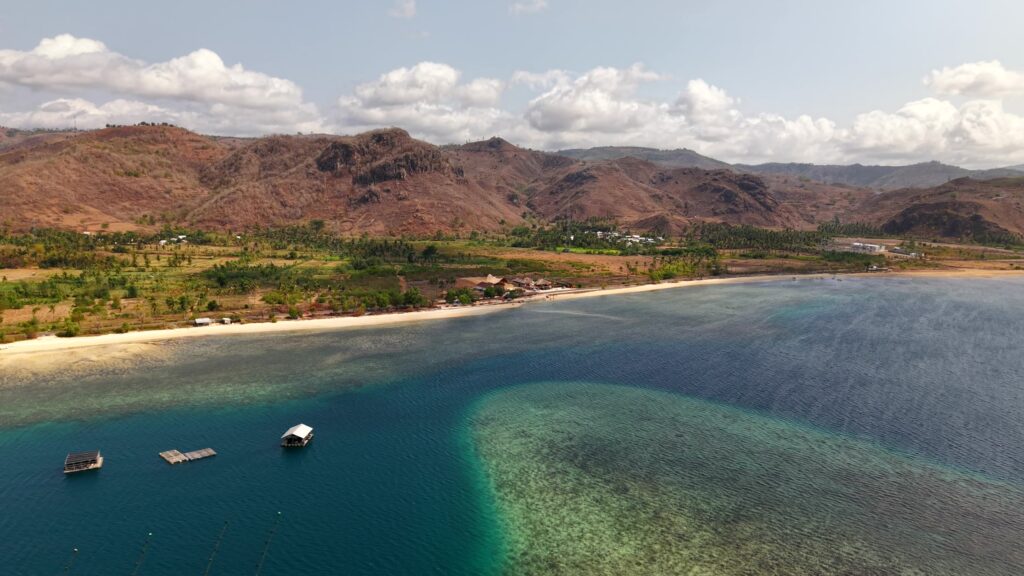
About 1 hour 10 minutes by car from Lombok International Airport. We offer a stay programme of 3 nights/4 days or more, with island trips by local boat and sunsets at SAKURA CAFE. The villas are due to be completed in stages from 2027.
Sources used for this article
- Good News From Indonesia, “Mengenal Tradisi Presean di Lombok” (22 November 2023; rain-ritual origins, stick and shield, clothing, referees, winning and losing, the market on Gili Trawangan)https://www.goodnewsfromindonesia.id/2023/11/22/mengenal-tradisi-presean-di-lombok
- Soewena, Pamadhi and Azmi, “Building Sportivity Through Appreciation of Tradition Peresean in Sasak Tribe Lombok” (Atlantis Press, 2020; rules, equipment, referees, rounds, timing)https://www.atlantis-press.com/article/125941653.pdf
- Solikatun, Karyadi and Wijayanti, “Eksistensi Seni Pertunjukan Peresean pada Masyarakat Sasak Lombok” (SANGKéP, 2019; fieldwork in Karek village, occasions today)https://journal.uinmataram.ac.id/index.php/sangkep/article/view/349
- detikBali, “Mengenal Gendang Beleq, Alat Musik Tradisional dari Pulau Lombok” (2 March 2024; meaning, players, instruments, nyongkolan, war origins)https://www.detik.com/bali/budaya/d-7221668/mengenal-gendang-beleq-alat-musik-tradisional-dari-pulau-lombok
- Wikipedia, “Gendang Beleq (dance)” (13 or 17 players, male and female drums, occasions)https://en.wikipedia.org/wiki/Gendang_Beleq_(dance)
- Liputan6, “99 Desa Wisata Halal di Lombok-Sumbawa” (18 November 2018; gendang beleq and peresean as village attractions)https://www.liputan6.com/regional/read/3695166/99-desa-wisata-halal-di-lombok-sumbawa